
Most business owners in South Africa have heard of it, and it’s a fast-growing short-term loan option, but what is bridge financing, and how can it help a small business?
Knowing how to get small business funding is tough for SA business owners, especially when many lenders ask for an immaculate credit history and set high-interest rates.
This is where bridging finance can help get a small company out of a hole: much like a bridge, it can help you quickly cross the turbulent waters of financial uncertainty.
Carry on reading to find out everything you need to know about this type of short-term financing, including:
- What is bridge finance in South Africa?
- What are the different types of bridging finance?
- How does bridge financing work?
- The risks of bridge financing
- The benefits of bridge financing
- How long does it take to get bridge financing?
Looking for bridging finance to get your business back on track? Get in touch with Lula today and find out how you can get flexible funding in just 2 hours.
What is bridge financing in South Africa?
You may have heard of people talking about short-term funding in the form of a bridge loan, but you may not be sure what is meant by bridging finance.
Put simply, bridging finance, or gap financing, is a quick and flexible way to cover operational costs or repayments for businesses.
Probably the quickest type of SME funding around, lasting anything from a month to a year, bridging finance is great for SMEs that are struggling to pay overheads, salaries, and working capital in the short term or just need a way to manage cash flow risk.
What are the different types of bridging finance?
The answer to the question “What is bridge financing?” can come in several different forms because of the various types of funding that fall into its category.
Bridge financing is most commonly used in business, but it’s also possible to get personal bridging loans to buy a new house or fund home improvements.
Here are some of the most common in South Africa today.
- Bridging credit facilities for businesses
A longer-term financing option than a bridging short-term loan, these encompass several financial products and arrangements, including the following.
Lines of credit: An overdraft-style facility within a certain limit that businesses can access to cover short-term expenses or capitalise on opportunities at any time.
Trade finance facility: Provides financing for international trade transactions, such as importing and exporting goods, through instruments like letters of credit or trade finance loans.
Invoice financing: Enables businesses to access funds by selling their accounts receivable to a financial institution at a discount, providing immediate cash flow while waiting for customer payments.
1. Real estate bridge loan
Used by people buying a new home as much as by businesses, a real estate bridge covers the gap between the purchase of a new property and the sale of an existing one.
These are used by both businesses and new homeowners to smooth the wheels of purchase while waiting for the sale proceeds of their current property.
Such loans are typically secured on the borrower’s existing property or their new real estate.
2. Equity bridge financing
Companies use this type of financing to cover urgent capital needs, like when there’s a deficit in start-up, takeover, or merger funding or in large corporate transactions.
Equity bridge financing covers the investment until the business secures permanent financing. It might also be structured to be repaid with the proceeds of share issues like IPOs, but this typically concerns large companies rather than SMEs.
How does bridge financing work?
Securing bridge financing is a quicker process than getting a longer-term financing option, but there are still several steps businesses must normally follow to do so.
If you’re a business owner looking for bridge financing, here’s a quick guide on what you’ll need to do.
1. Applying for funds
Once you know how much money you’ll need and for how long, you can start applying. This means filling out a paper or digital form with your details and reasons why you need the money. You’ll also typically be asked to provide your ID.
However, many alternative online lenders are replacing form-filling with a quick online application that asks for just your name and contact details in return for a commitment-free quote. This is helping to slash waiting times for business owners in need of fast funding.
2. Lender checks
The lending company will assess your status and current situation to determine whether you qualify for the funding you request. They’ll often carry out a credit check to calculate the risk of default, and they might ask you to name a guarantor who is responsible for repayment should you not be able to do so.
3. Get the funds
If you pass the checks, a process that might take several days, you will be approved for the full loan amount or a percentage of this. If you accept it, you will receive the agreed amount. Most lenders will charge you interest from this point.
All in all, this process should take days, rather than weeks or months, between applying and accessing the funds. And with alternative lenders, it is much faster (such as with Lula, which allows access to funding within 2 hours from approval).
What is bridge financing? The risks to look out for
They might be fast and convenient, but there are several cons of bridging loans that we should consider.
The cost of borrowing can be higher.
The cost of borrowing, including interest rates, is one of the first things we should look at when taking out financing, and this tends to be higher for bridging loans than almost any other type of loan. This is due to their short-term nature.
Funding Hub, a South African finance app, recently looked at 40 SA-based bridge lenders and found that they can charge interest of up to 5% of the financed amount per month. That’s 60% per year and a potentially huge business expense.
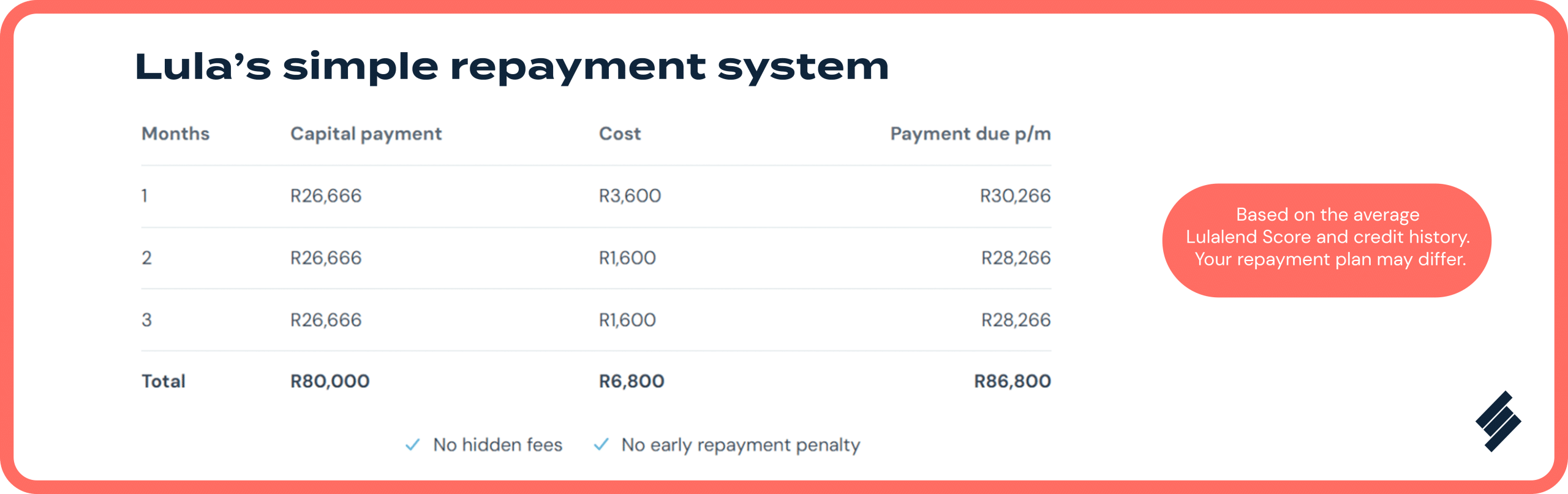
Such high fees have led to a market for alternative lenders that charge much lower fees, such as an agreed monthly fixed cost, rather than jumping on the rollercoaster of volatile interest rates. Lula is one example, offering a straight-up and simple cost plan so that borrowers know from Day 1 exactly how much they need to repay.
Lula’s simple repayment system
How to calculate interest on bridging loans
Here’s what the interest would look like on a loan of R100,000 at a rate of 2.5% and 5%.
2.5% interest rate
Monthly interest = R100,000×0.025
= R2,500
Yearly interest = R2,500 x 12
= R30,000
5% interest rate
Monthly interest = R100,000×0.05
= R5,000
Yearly interest = R5,000 x 12
= R60,000
Interest amounts at 2.5% and 5% for R100,000 and R500,000
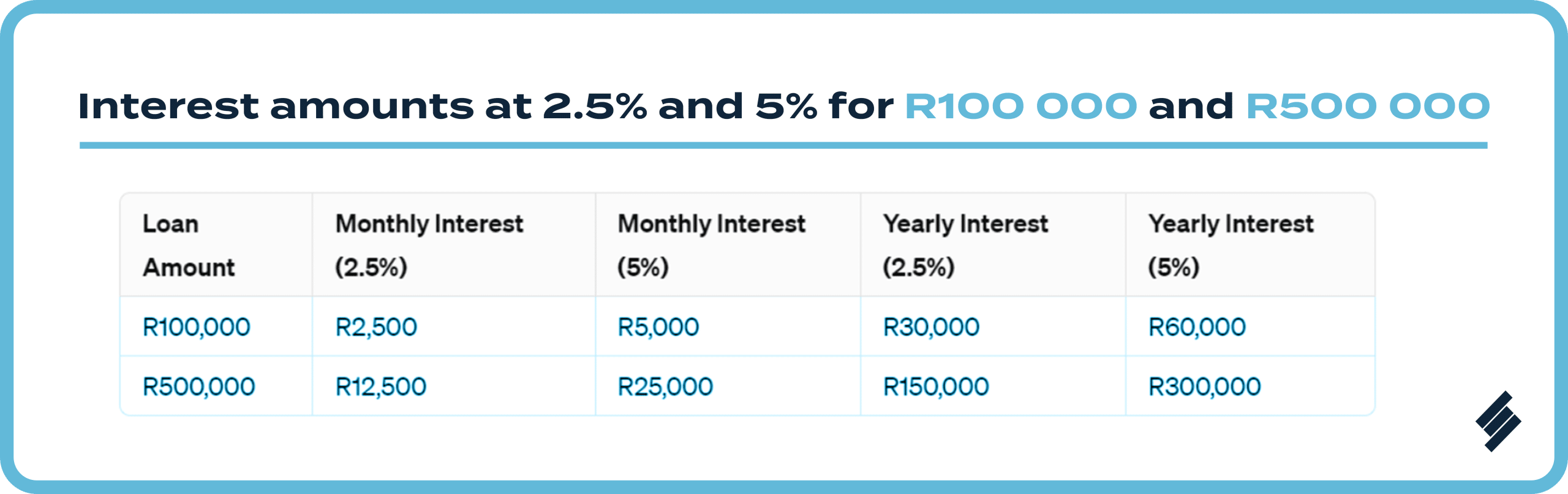
As you can see, a hike of two or three percent in the interest rate can make a huge difference to the amount of interest you pay back on traditional business loans.
Better still, if you agree to a lower monthly fixed cost instead of an interest rate, you can bring this fee down even further.
Bridge lenders often require collateral
Borrowing bridge finance comes with penalties for non-repayment to protect the lender’s interests, like with any other type of lending.
Often it’s a secured debt, which means that the lender demands collateral (i.e. equipment or property) from you should you fail to repay the owed sum.
This makes it crucial to have a solid repayment plan in place for any type of bridging finance.
Yet this collateral requirement often excludes SMEs just starting out that don’t have sufficient assets to secure their debt against. This is another reason why there are alternative lenders out there, like Lula, that now offer collateral-free lending.
Bridge financing tends to come with a shorter repayment period
Bridging finance is short-term by nature, but this also means you’ll have less time to repay what you borrow.
This can be a source of acute financial stress if you’re not ready for it, but it does mean that there are no early repayment fees, like with longer-term finance.
It can also be something of a plus. As Forbes contributor and businessman John Lettera puts it: “The relatively short tenor of the bridge loans often mitigates the impact of their higher rates”.

“The relatively short tenor of the bridge loans often mitigates the impact of their higher rates”
— John Lettera, Forbes contributor and businessman
In short, the quicker you can pay it off, the less important the higher interest becomes!
What is bridge financing? Top 5 benefits
1. It boosts cash flow
Bridging finance is a great way to inject life into your immediate cash flow. It frees up money to meet urgent financial needs, seize business opportunities, or fund time-sensitive projects.
Cash flow and late payments are the chief worry for 91% of SA small businesses, according to SME resource Xero, which explains why many business owners have turned to bridging finance.
2. It serves multiple funding needs
Need to buy new machinery? Pay employee wages? Or maybe just unforeseen expenses?
Bridging finance helps you out with all these things. In fact, South African small businesses use it for a wide spectrum of expenses, ranging from property development to buying out partners.
Bridging finance uses for SA small businesses
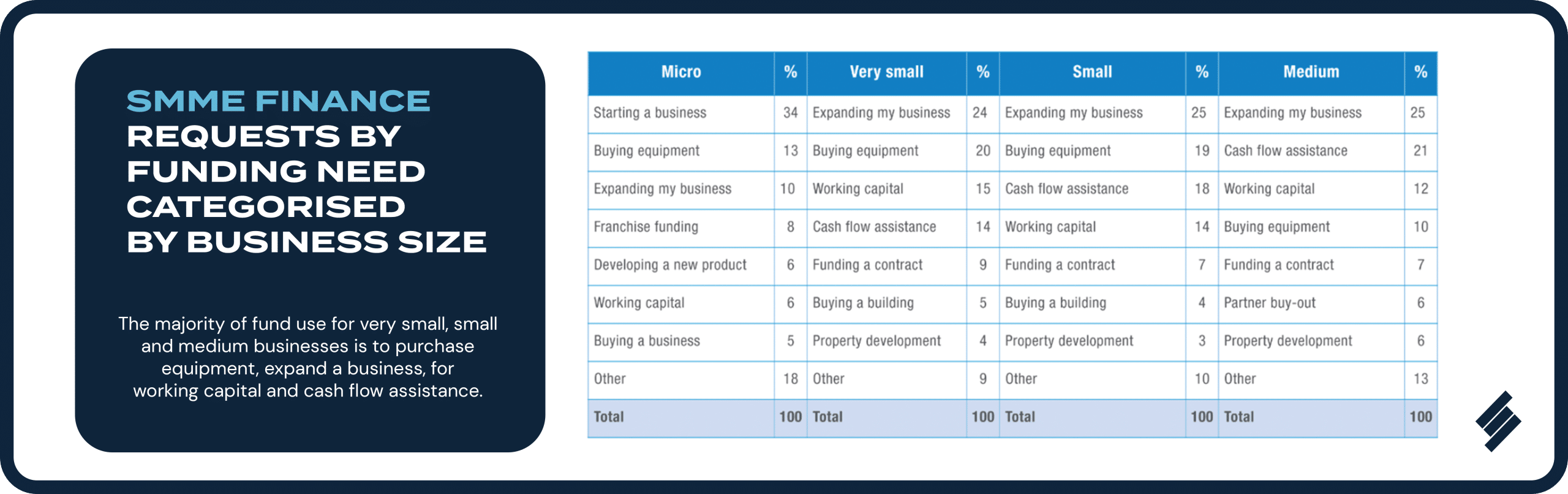
Source: Ecommerce.co.za
This is different from a lot of longer-term borrowing, where the lender often asks you the exact purpose of your application to help them assess risk.
3. Its lending requirements are lower
Many bridge lenders don’t ask for collateral and offer unsecured funding to business borrowers.
This means it can be a boon for all types of businesses, from eCommerce retailers to small manufacturing companies and even startups looking to scale their operations rapidly.
Lula’s business funding, for example, offers up to R5 million to small businesses. Applicants just need to fill in a few simple details and upload their recent bank statements to receive a quote without the need for lengthy paperwork or proof of collateral.
4. It helps you build your credit history
Taking out bridging finance and successfully paying it back will allow you to build up a poor credit score.
By doing so, you’ll prove to future lenders that you are capable of financial planning and paying a debt back.
In many cases, bridging finance is a “bridge” to funding that can shape your business’s long-term future.
5. It’s faster than other types of financing
Bridge financing is one of the fastest types of funding around, with borrowers having to jump fewer hurdles to get it.
As such, it’s perfect for seizing quick business opportunities or for plugging short-term expenses.
How long does it take to get bridging finance?
The time it takes for bridge funding to land in your bank account depends on the lender you choose.
Banks and other traditional loan lenders often ask you to fill out lots of paperwork and provide proof of credit and financial statements, which drags out the application process to days or even weeks.
Some lenders, however, do away with pen-pushing and red tape and just ask you to fill out a quick digital form. They’ll then provide you with a commitment-free quote in hours rather than wait around to receive paper forms from you.
Once you accept, they’ll then have the money in your accounts in just a couple of hours, meaning you can swiftly address your business’s financial needs the same day you apply.
Time is money. Apply for bridge financing today and get access to funding within hours. Lula offers up to R5 million in unsecured funding, depending on your company’s valuation.