
South Africa’s construction sector is gaining momentum. Public infrastructure projects and renewable energy builds are increasing, and demand for capable contractors is rising across the country.
For established construction businesses, there is no shortage of opportunity – but opportunity alone doesn’t guarantee profitable growth.
Experienced business owners know that new projects often require cash long before payments come through. Material costs can shift between quoting and delivery, and expansion decisions carry real financial risk.
Without a clear construction business plan, growth can quickly strain working capital instead of strengthening it.
If you’re running an established business, you’re likely facing construction challenges that didn’t exist when you first started, including:
- Cash flow gaps between project expenses and client payments eating into your working capital;
- Rising material costs and supplier price volatility squeezing profit margins on projects you quoted for months ago; and
- No clear financial road map about which expansion opportunities to pursue, whether it’s investing in new equipment or entering new niches.
Scaling a small enterprise requires careful planning – and that’s exactly what a business plan helps you do.
This guide outlines the core elements of a business plan, then walks you through eight financially focused steps to build a construction business plan grounded in South Africa’s realities.
The steps are designed to support funding applications, larger tender bids and stronger financial decision-making – helping you create a plan that works in practice, not just on paper.

What Makes a Construction Business Plan Different for Established Businesses?
When you’re starting in the construction business, your business plan is mostly projections and promises – hypothetical revenue figures, estimated costs and optimistic timelines.
Once you’ve been operating for a year or more, everything changes. Your construction business plan becomes a strategic road map backed by historical data.
You now have projects completed, a network of client relationships, historical cash flow patterns and profit margins to base projections on.
By now, you should know which types of projects deliver the best returns.
You understand actual overheads not some industry averages, and you’ve experienced the cash flow reality of construction – those payment gaps between laying out money for materials and labour, and actually getting paid by clients.
Building a construction business plan is about demonstrating to funders that you understand your numbers, your market and exactly how you’ll turn investment into net profit.
Most of all, it’s about giving yourself the strategic clarity to avoid common business mistakes and make expansion decisions with confidence.
The need for working capital in the construction industry
For established enterprises, a construction business plan needs to address working capital management, not just start-up capital. That’s because construction is fundamentally different to most industries.
Construction projects require large amounts of working capital, not capital outlay, to finance labour, materials and equipment during the gaps between when you spend money and when clients pay you, the Construction Industry Development Board (CIDB) notes in their financial modelling research.
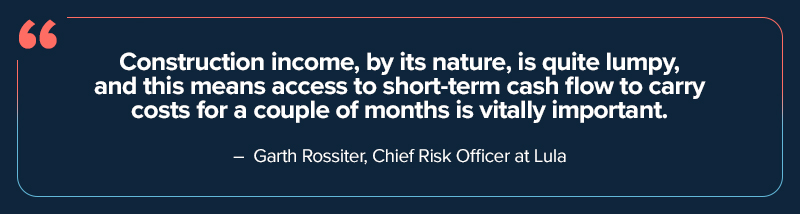
This construction finance challenge is what Garth Rossiter, Chief Risk Officer at Lula, describes as lumpy income. “Construction income, by its nature, is quite lumpy, and this means access to short-term cash flow to carry costs for a couple of months is vitally important,” he explains in a recent analysis of the sector.
So how do you write a construction business plan that takes this challenge into account?
Answer: Your business plan should use your track record to show that your business is stable and profitable. Include your CIDB registration and grading, highlight completed projects with client references, and base your growth projections on your actual financial performance.
What Are The 8 Main Points in Construction Business Plan Templates?
You may not need to know how to write the perfect business plan to reach your goals, but it helps to understand the core structure that funders and business partners expect to see.
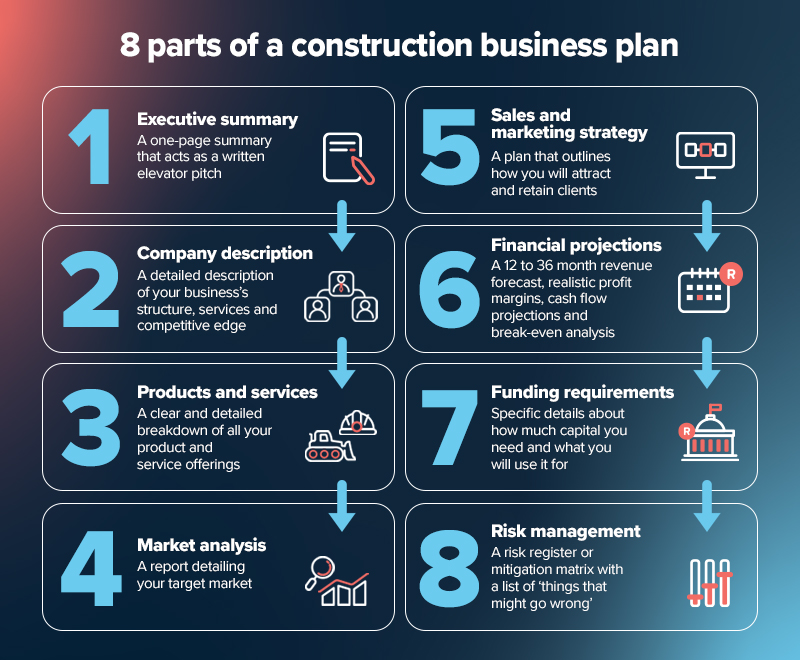
Your document should include seven main parts:
1. Executive summary
This is your one-page overview covering who you are, what you do, where you’re heading and how much funding you need. Think of it as an elevator pitch in written form.
2. Company description
Here you detail your business structure, history, CIPC registration, CIDB grading, services offered and the specific market segments you serve.
For construction businesses, this section should highlight your competitive advantages, which might include specialised expertise, equipment ownership, safety record or established supplier relationships.
3. Products and services
A clear breakdown of your construction services, whether that’s residential building, commercial fit-outs, industrial projects or specialist niches like renewable energy installations, is important.
4. Market analysis
This demonstrates you understand SA’s construction landscape and market size, industry trends, your target clients (private sector, government tenders or both) and who you’re competing against.
5. Sales and marketing strategy
How do you attract and retain clients? The sales and marketing plan covers your tender process, referral networks, relationships with architects and engineers, and your approach to securing repeat business.
6. Financial projections
This is the heart of your plan. The financial projections should include 12- to 36-month revenue forecasts, realistic profit margins, detailed cash flow projections and break-even analysis.
For construction businesses, this section demands extra attention because funders want to see you understand the ‘lumpy’ nature of construction income.
7. Funding requirements
These include specific details about how much capital you need, what you’ll use it for (working capital, equipment, expansion), when you need it and how you’ll repay it.
Most funding providers pay special attention to how well you understand your funding requirements.
8. Risk management
While not included in standard business plan examples, some frameworks add risk management as an eighth component. When done well, it can help your business stay stable under pressure risks, including changing material prices and delayed payments.
For construction businesses dealing with lumpy income, sections six, seven and eight are particularly important, and this is what forms the basis of writing your business plan.
8 Financially Sound Steps to Writing Your Construction Business Plan
The following eight steps provide the financial plan that established construction companies follow to secure funding, win larger tenders and scale profitably.
Each step focuses on strategies that work specifically in SA’s construction environment.
1. Analyse your historical financial performance
Knowing how to write a construction business plan means knowing your past.
Start with a step-by-step analysis of your past 12 to 36 months of financial data. This historical analysis becomes the foundation for every projection you’ll make in your business plan.
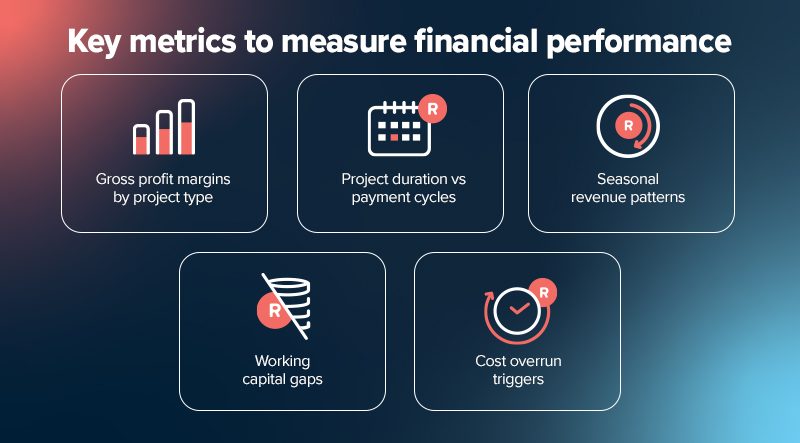
Pull bank statements, income statements, cash flow statements and project-level profit and loss records to look for patterns. Here’s what you’re looking for:
- Gross profit margins by project type: Compare against averages in South Africa – commercial construction profits historically average around 2.2% to 3.5%, according to market research by advisory firm Aviaan.
- Project duration versus payment cycles: Track when cash arrives versus when expenses hit.
- Seasonal revenue patterns: Identify high and low cash flow periods.
- Working capital gaps: Calculate the typical delay between paying suppliers and receiving client payments. This ‘lumpiness’ needs to be visible in your business plan because it directly affects your funding strategy.
- Cost overrun triggers: Which projects exceeded budgets and why? Was it scope creep, material price increases, labour inefficiencies or timeline delays?
According to a 2025 Lula Small Business Survey of 815 SME owners, 56% identify cash flow as their biggest business challenge. Understanding where your cash gets stuck helps you plan better.
A cash flow analysis tells you which types of projects to prioritise as you scale, which cost centres need tightening, and what your realistic growth trajectory looks like based on actual performance instead of optimistic guesses.
2. Define your construction niche and target market
What’s the most profitable construction business to operate in? For experienced construction companies, SA’s construction market offers some profitable business ideas.
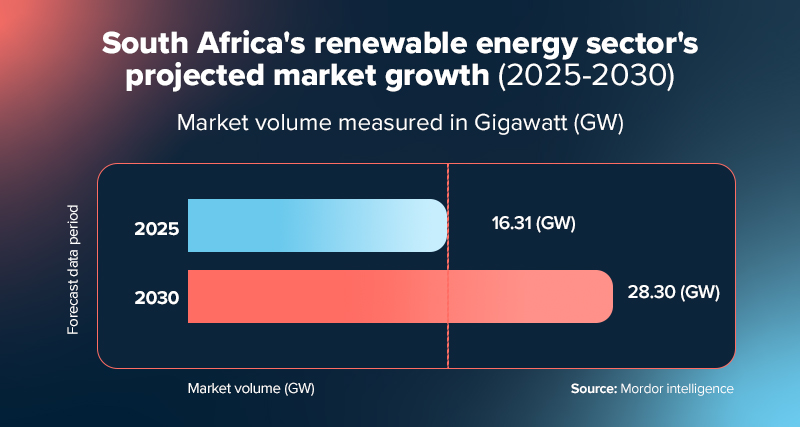
For instance, renewable energy installations are projected to grow 74% by 2030, according to market analyst Mordor Intelligence, with a compound annual growth rate exceeding 11%. That’s driving massive demand for construction services.
Established businesses should double down on what already works for them while potentially expanding into high-growth niches. If you’re in residential construction, why not offer energy retrofits with your renovations, for example?
The key here is trusting in your own business and choosing niches where your years of experience count most.
3. Detail your services and competitive advantages
What is it that sets your construction business apart in a crowded market? Your business plan needs to answer that question with specifics, not copy-paste claims about “quality workmanship” or “excellent service”.
Do a competitive analysis on what sets you apart, including:
- Completed projects with references: Promote complex or high-value work you’ve delivered. Document completed projects with references, offer your repeat business rate and highlight any particularly complex or high-value projects you’ve delivered successfully. Your track record proves capability in a way that new entrants simply can’t match.
- CIDB registration and grading: Non-negotiable for government work, the CIDB Act makes it illegal to undertake public sector construction without valid registration. Your grading (1 to 9, based on financial capacity and technical capability) determines which tender values you can bid on. If improving your grading is part of your growth strategy, spell that out in your business plan with a timeline and the requirements you’ll need to meet.
- Equipment ownership: Equipment doesn’t just look good on your balance sheet. Another strong advantage, having your own equipment reduces operating expenses and improves profit margins.
- Supplier relationships: Supporting your operations plan with a strong supplier network and partnerships makes it easier to deal with material and staffing shortages – an ongoing challenge in South Africa.
- Technology systems: Project management software, cost tracking, AI marketing tools, BIM adoption – these are important tools in your arsenal. Morag Evans, CEO of construction database Databuild, notes that “advances in technology have empowered those in the sector to become more efficient”.
As an example, Evans argues that “using real-time monitoring solutions like sensors, meters and data analytics platforms can assist builders in monitoring water usage and help detect leaks much faster on construction sites. This can lead to significant water savings and cost reductions”. - Safety record: Think of professional indemnity, public liability and documented health and safety management (needed for higher CIDB grades). All these demonstrate the business maturity and high-quality service that funders and clients look for.
Your competitive advantages should link directly to financial benefits: faster completion means lower overhead, specialised expertise commands higher rates, and strong supplier terms improve cash flow.
That’s what funders want to see: not just what makes you different, but how those differences drive profitability.
4. Create detailed financial projections based on real data
This is where established businesses have a massive advantage over starting entrepreneurs. Instead of guessing, project forward from actual performance. Your financial projections should cover 12 to 36 months and include revenue forecasts, profit margins and cash flow analysis.
Start with your project pipeline:
- Secured contracts: List with start dates and payment schedules
- High-probability prospects: Include tender negotiations already underway
- New business estimates: Based on historical win rates
Apply realistic profit margins to each project type using your historical data. Don’t inflate numbers – funders will see through that immediately.
Also, remember to account for SA-specific variables, like rising material costs. Build escalation clauses into projections. Your cash flow projections must reflect construction’s ‘lumpy’ payment patterns – when expenses hit versus when payments arrive.
5. Map out your working capital and funding strategy
Working capital is perhaps the biggest financial challenge for SA construction businesses, because construction typically requires large sums to finance labour, materials and equipment during payment gaps.
Specify exactly how much you need, what for, when and how you’ll repay it from project completion payments:
- material costs (adjusted for inflation);
- labour and subcontractor payments during execution;
- equipment costs (rental or finance);
- overhead during revenue gaps; and
- contingency buffer (10-15%).
Detail your funding strategy. Funding for construction companies from traditional banks requires collateral and imposes rigid terms that don’t match construction cash flow patterns.
This mismatch between traditional funding practices and the needs of small businesses results in a R350 billion funding gap, a 2025 report from finance database Finfind concludes.
Luckily for the construction sector, South Africa’s funding ecosystem is bigger than banks. Recent years have seen non-bank digital lenders entering the market to serve specific gaps, the report notes.
These lenders understand small business realities and are better placed to help them.
Lula’s Cash Flow Facility, for example, lets you draw funds only when you need them and pay only for what you use, with no fees for unused funds.
This makes it a better fit for construction’s uneven income than a loan with fixed monthly repayments, even during months when project payments haven’t come through yet.
6. Outline operational efficiency and cost management
When margins range from 2.2% to 3.5%, operational efficiency determines business survival. Show funders you understand where costs hide.
Key strategies to document are:
- Supplier diversification: Spreads shortage risk and material cost volatility
- Bulk purchasing agreements: Lock in prices to mitigate inflation
- Equipment ownership analysis: Model when owning beats renting based on utilisation
- Technology adoption: Project management systems reduce timeline overruns and overhead
- Contingency budgeting: Build 10-15% buffers for unexpected costs
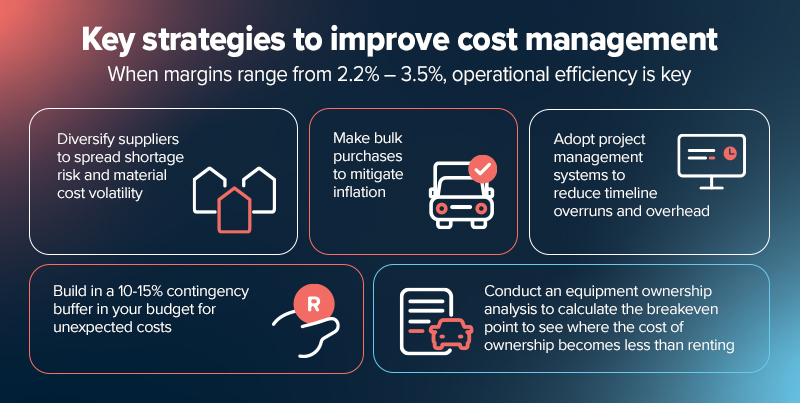
When clearly set out in your business plan, these strategies show that your business runs efficiently and can keep operating even when profit margins tighten across the industry.
7. Develop risk management and mitigation strategies
As experienced business owners know, the construction market faces unique risks. Showing you’ve identified them and have mitigation strategies demonstrates the business maturity funders look for.
Address these key risks in your plan:
- Cash flow volatility: Working capital facilities or reserves to bridge payment gaps
- Material cost inflation: Escalation clauses in contracts, fixed-price supplier agreements
- Material shortages: Multiple suppliers for critical materials, longer lead times
- Client payment delays: Progress payments, upfront deposits, retention clauses in contracts
- Load-shedding legacy: Buffer time in schedules and force majeure clauses (when circumstances beyond your control, like power outages or natural disasters, prevent you from meeting contractual deadlines)
- Insurance coverage: Professional indemnity, public liability, contractor’s all-risk
- Safety compliance: H&S management systems required for higher CIDB grades
The key is demonstrating you’ve thought through the specific risks your business faces and have practical, funded mitigation strategies. This shows the business resilience that funders look for when deciding whether to back your growth.
8. Include implementation timeline and milestones
A business plan without a timeline is just a wish list. Adding this final section transforms your strategy into actionable steps with specific dates and measurable milestones.
Create a clear road map that includes these details:
- CIDB grading upgrades: Timeline and documentation requirements for moving upgrades
- Revenue targets by quarter: Based on your project pipeline and historical win rates
- New construction service launches: Training, equipment and certifications should be carried out first
- Equipment investments: Tied to project needs and funding availability
- Review points: Quarterly financial reviews comparing actuals versus projections
If you’re expanding into renewable energy installations to capitalise on that 74% market growth, when will you launch? Break big goals into smaller milestones with dependencies mapped out.
Your implementation timeline proves you’re serious and gives funders confidence you’ll use their capital strategically with clear accountability. It also gives you a road map to follow as you execute your growth strategy.
How to Unlock Funding Without a Construction Business Plan
You’ve built a comprehensive, financially sound construction business plan. Now what? For most established construction businesses, the next step is securing the funding to execute that plan.
Banks require extensive documentation alongside business plans, including multiple years of audited financials, collateral valuations, personal guarantees and weeks (sometimes months) of back-and-forth before making a decision.
Even when presented with a strong business plan, however, approval isn’t guaranteed. Also, when funding does come through, it arrives with rigid monthly repayment schedules that don’t match your project-based income cycles.
Lula works differently. We understand construction’s specific challenges and evaluate established businesses on their actual performance. To qualify for Lula’s construction funding, all you need is:
- At least one year of trading history;
- Minimum annual turnover of R500,000;
- CIPC registration and healthy credit history; and
- Recent bank statements showing your cash flow.
This means no elaborate business plan is required, no collateral is demanded, and you don’t have to wait months for your funding.
We evaluate your business holistically, looking at actual performance, cash flow patterns and growth potential, alongside credit history.
Because we understand construction’s ‘lumpy’ income reality, we’ve designed funding that matches how your business actually operates.
Our Cash Flow Facility operates as flexible credit where you only pay for what you use – matching lending to project-based income rather than imposing rigid repayments.
Our Fixed-Term Funding provides up to R5 million with flexible terms and no early repayment penalties. With decisions within as little as 24 hours for qualifying businesses, you can move quickly when opportunities arise – and not when your bank tells you so.