
Do you have a unique business idea, and your business is already off the ground, but you find that several obstacles are preventing you from making it official?
We’re here to guide you on how to register your business idea in South Africa.
Securing your business idea is an exciting yet daunting process, but knowing how to go about the process vastly improves your chances of succeeding and protecting your unique idea.
Not registering a business idea exposes it to copyright issues and legal problems.
Phase 2 of the National Intellectual Property Policy focuses heavily on ‘Digital Blueprints’. This means that if your business idea is a digital product or software, registering the code or UI design as Intellectual Property (IP) is now as critical as the company registration itself.
This is what you need to know before registering a business idea in South Africa:
- Understand the company registration process, including how to register your business with the Companies and Intellectual Property Commission (CIPC)
- Knowing how much registration costs, including how this varies according to business type
- What you’ll need to do after registration
The sooner you jump these hurdles, the more likely you are to make your business idea work. In this blog, we explain how to register a business idea in South Africa, outlining the exact step-by-step process.
How to Register a Business Idea in South Africa
Registering a business in South Africa and registering a business idea are two different processes. Both can be done on the CIPC website. To register a business idea, you first need to have a registered business.
It’s important to distinguish between the two processes.
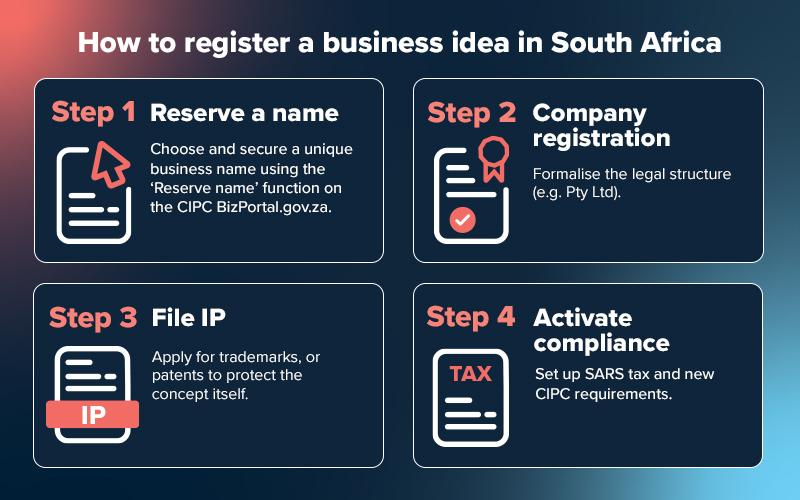
Registering a business creates a formal legal entity (like a Pty Ltd) that allows you to trade, open a bank account and pay tax, whereas registering a business idea involves protecting your IP from being stolen by competitors.
There are different types of IP, like a trademarked logo, a patent or software code. Here are the foundational steps you need to take to register a business idea in South Africa:
1. Define your business idea
Talking about how to register a business idea in South Africa is all well and good, but the hardest part is defining the idea in the first place.
We can simplify this process by breaking it down into two stages, according to business consultant and keynote speaker, P Simon Mahler. “Finding your niche idea for a small business is a journey of self-discovery and market exploration,” he commented in a recent guide.

If you’re a small business that’s already taken your idea to market, this may help you to define your idea more clearly.
By following these steps, according to Mahler, you’ll be well on your way to discovering your niche.
2. Gather the essential documents
The next step is to make sure you’ve got all the right documentation on hand. Think of these documents as your business’s birth certificate and instruction manual.
You’ll need:
- Notice of Incorporation: This outlines key details like your company type, founding date and registered address. It also specifies the number of directors, your chosen company name, and even potential back-up names for the CIPC to review.
- Memorandum of Incorporation: This document details your company’s founding members and the amount of initial share capital.
- Proof of identity: Certified copies of your ID and any initial directors’ IDs.
The not-so-essential-but-useful-to-have documents:
- Pre-reserved name form: Have you reserved a great business name beforehand? Submit your valid name reservation document to help things along.
- Business plan: A specific plan for your business will help clarify the registration costs for your business and ensure you don’t overpay.
3. Select your Intellectual Property category
Before you file a single document, you need to know exactly what you’re protecting. Mapping your assets to the correct legal path ensures you don’t leave your most valuable ideas, processes or branding vulnerable to copycats.
Here are the different paths you can take when registering your business idea:
- Copyright: This includes original written works, source code, API documentation and marketing copy
- Trademarks: Your business name, logo, slogans and unique product identifiers
- Patents: Unique technical inventions or specialised industrial processes
- Functional designs: The layout, navigation flow and specific ‘look and feel’ of software or product interfaces
4. Check if your idea already exists
Before you go ahead and register your business idea, you’ll need to verify that it isn’t already claimed. Use the CIPC’s IP Online Portal to conduct a preliminary search across South Africa’s national registers for trademarks, patents and designs.
This due diligence prevents costly legal disputes and ‘cease and desist’ letters from coming your way.
5. Register your business idea
Once you’ve chosen your specific IP path and you’ve verified that your idea really is unique and hasn’t been claimed by another business, you can move on to registering the idea on the CIPC website.
Securing your future involves more than just an IP. You must also ensure your Beneficial Ownership (BO) details are filed with the CIPC.
Since 2023, this is a mandatory requirement for all South African companies and Close Corporations. Failing to file BO declarations alongside your annual returns can lead to your company being deregistered, which neutralises your IP protection.
Where Can I Register My Business Idea in South Africa?
The CIPC website is the one-stop shop for online registration. Once you’ve registered as a CIPC customer and registered your business, navigate to the CIPC Home Page and click on IP Online.
To trade legally and own the IP under a business entity, you should have a registered company.
The process is simple:
- Select your category: Trademarks, Patents or Designs
- Apply: Click on ‘New Application’
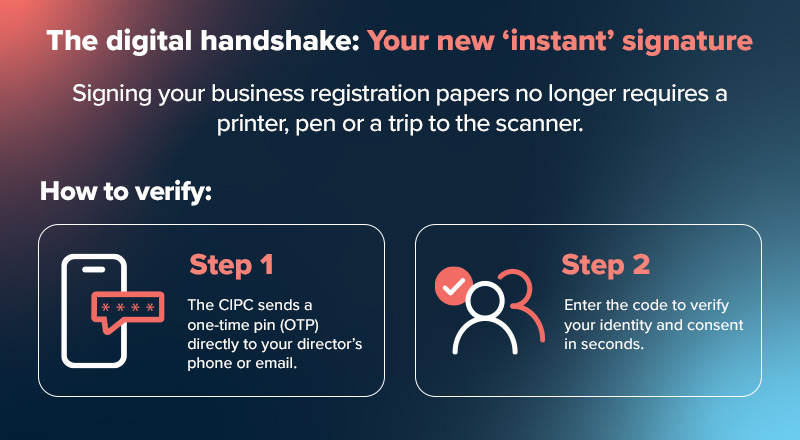
- Verify your identification: Within the application form, navigate to the ‘Owners/Directors’ section. Here, you will have to input the ID numbers and contact details of all the company stakeholders. Click ‘Initiate Verification’. The system will instantly send a secure link and OTP to every director. Each person must click their unique link to ‘handshake’ the application. The status on your screen will turn from ‘Pending’ to ‘Verified’ as they complete this.
- Upload your documents: Scroll to ‘Lodgement Requirements’ or ‘Uploads’. Use the integrated Home Affairs link to pull verified ID data (manual ID uploads are not accepted for South African citizens). You can then upload all the other documentation that your selected IP category requires.
- Pay and submit your application: Click on the ‘Cart’ or ‘Payment’ button at the bottom of the summary page. Pay via the secure online card portal. Once your payment is confirmed, click ‘Submit to Registrar’. You will immediately receive an automated filing receipt and your application number via email.
How Much Does it Cost to Register a Business Idea?
Registering a business idea in South Africa is highly affordable if you handle the filings yourself through the CIPC IP Online Portal. The total cost depends on the IP category your business idea falls into.
Here is the pricing structure:
| IP Category | Form | Cost (Electronic) |
| Trademark | TM1 | R590 |
| Functional Design (UI/UX) | D1 | R240 |
| Provisional Patent (12 month) | P6 | R60 |
Why Registering a Business Idea at the Prototype Stage is Critical
The CIPC registration system operates on a ‘First-to-File’ basis.
Unlike some jurisdictions that may prioritise the person who first thought of the idea, South African law generally grants rights to the person who files the application first.
This means the quicker you register your IP, the quicker you’re protected.
Many entrepreneurs wait until they hit a certain revenue milestone before they invest in a patent or trademark. This delay creates a vacuum that competitors are happy to fill.
If a rival sees your prototype in the wild and realises you haven’t secured the rights to the idea, they can steal your innovation by filing their own application.
Once they have that filing date, they effectively own the idea, even if you were the original creator. You could end up paying royalties for an idea that was originally yours and get sued for infringement on a product you spent years developing.
Secure Funding to Start Scaling
Having a registered IP is a powerful intangible asset that significantly boosts your company’s valuation.
If your objective is to grow and scale, funders are always looking for reasons why your business is better than your competition and what differentiates your brand from others. A registered patent boosts your value and adds an extra layer of protection.
Having your IP signals that you are serious and low risk. It elevates your credibility in the eyes of funders and customers.
Protect the Future of Your Business
Registration is the engine of growth. It provides the legal foundation upon which you can build a brand, attract investment and eventually dominate your industry.
Protect your ideas, declare your ownership and give your business the fuel it needs to soar.