
Running a franchise is a profitable move in South Africa. Franchise brands are established, with proven systems and real market depth. The franchise industry already accounts for roughly 15% of South Africa’s gross domestic product (GDP).
So what does franchise funding South Africa look like for a business owner exploring this growth path?
Say you’ve been running a small business for at least a year and have real revenue behind you. You’re not starting from scratch. That changes everything about how you approach both franchising and franchise finance.
If that sounds like your situation, these are probably the questions keeping you from moving forward:
- What the complete costs look like: franchise fees are the entry point – but what about fit-out, stock, working capital and royalties?
- Business funding options suited to established businesses: how do you best go about financing an expansion if you’re already operational?
- Protecting your cash flow once the franchise opens: how to fund the new operation before it generates consistent revenue?
This guide covers more than just the basics of how to get funding for a franchise in South Africa.
We break down the costs of buying a franchise and weigh the pros and cons of eight franchise funding options in South Africa, not just any funding, but the kind available to business owners with turnover. We also explain how to keep a new franchise financed once you get it started.

The Actual Cost of Buying and Owning a Franchise Business
A franchise is a great business idea in South Africa, but before you approach a single lender for franchise funding, it helps to understand exactly what you’re funding. Most business owners focus on the headline franchise fee (the number franchisors advertise). But that figure isn’t the full picture.
One rule of thumb applies when you buy a franchise in South Africa. Most recognised franchise brands require 40–50% of the total investment in unencumbered funds.
That means you can’t just buy a franchise with funding. If your total investment is R2 million, you need R800,000 to R1 million in cash reserve before any credit provider will look at the rest.
A franchise investment can be broken down into four layers of cost:
- Upfront franchise fee
- Establishment cost
- Initial working capital
- Ongoing fees
The first is the upfront franchise fee: the amount you pay for the right to use the brand, its systems and its intellectual property. This can range from R60,000 to R250,000 or more, according to franchise directory Franchiseek.
The second cost layer is the set-up and fit-out: premises, equipment, signage and décor based on franchisor specifications.
A franchisor will often lay out minimum establishment investments in the franchise agreement. Estimates really depend on the operations and industry. For big fast food franchises, these costs easily run into millions of rands.
These investments can be recurring costs, which is what many franchisees fail to take into account.
Even beyond the initial outlay, refreshes need to be factored in, too. “Franchise agreements often mandate periodic ‘refreshes’ – new signage, digital menu boards, facility upgrades – which can be a sudden, heavy capital hit,” says Dumisa Jonas, Senior Relationship Manager at Lula.
The third layer is initial working capital: cash held in reserve to cover initial operating costs before the business starts generating consistent revenue.
Franchisors build this into the investment requirement because it’s crucial for early-stage business survival.
Smart franchise operators often use working capital finance to keep the business moving through the initial stage.
Last comes the ongoing fees: royalties (typically 4–12% of monthly turnover), marketing levies and management fees, which continue for the life of the franchise agreement.
For example, Chicken Licken charges a combined 12%, split evenly between royalties and advertising, according to SME South Africa.
What often catches franchisees off guard is how the fees are calculated. “Royalties and marketing levies are charged on turnover, not profit,” says Jonas. “If inventory and capital reserves have already been stretched, servicing those monthly fees becomes a real cash flow strain — even when the business is technically generating revenue.”
What’s the Most Profitable Franchise to Own in South Africa?
Fast food leads on volume and repeat customer frequency — KFC alone operates over 1,000 stores nationally, and McDonald’s has more than 370, according to SME South Africa’s 2025 franchise outlook. Retail and grocery franchises like SPAR carry strong margins through consistent foot traffic.
But profitability comes down to more than brand recognisability. Location, management quality and how well the funding structure is designed from day one all determine whether a franchise booms or goes bust.
What’s the Cheapest Franchise to Buy?
Entry-level options exist well below the R500,000 mark. Home services and mobile food concepts can be entered from as little as R50,000 at the lower end of the market.
The biggest downsides to buying a cheap franchise are limited brand recognition and less business support.
These smaller franchises carry more operational risk and generate less revenue. For an established business owner looking to use franchising as a serious growth vehicle, the mid-to-upper tier of brands might make more sense. Chasing the lowest entry cost only makes sense for entrepreneurs starting out in the industry.
7 Best Franchise Funding Options in South Africa
When it comes to franchise funding, the more established your business, the more funding options you have. The right structure often combines multiple sources to cover the different cost layers that the previous section outlined.
Here is a working overview of franchise funding options in South Africa.
1. Bank franchise divisions
South Africa’s five major banks operate dedicated franchise finance desks. These are not general business lending teams.
They have existing relationships with recognised South African franchise brands and understand how franchise businesses are structured financially.
If you know how to apply for a business loan with banks, then you’re familiar with their extensive funding applications.
Franchise finance is often more rigorous than term loans: the application form usually includes written franchisor approval, a signed franchise agreement, a comprehensive business plan, a copy of the lease agreement, six months of business bank statements and signed financial statements with a 12-month cash flow projection.
Finally, the 50% unencumbered deposit is a hard requirement for banks.
Pro: Highest funding ceilings
Pro: Brand familiarity speeds up assessment for established names
Con: Documentation requirements are extensive
Con: Approval timelines are among the longest
2. SEDFA
The Small Enterprise Development Agency (SEDA) and Small Enterprise Finance Agency (SEFA) merged in October 2024 to form the Small Enterprise Development and Finance Agency (SEDFA). The SEDFA administers a dedicated franchise fund in partnership with FASA, covering set-up costs, equipment and working capital, with a maximum of R15 million per application.
According to a November 2025 episode of the SEDFA Podcast, applicants need to be tax compliant, CIPC registered and operating for at least two years – at least for some SEDFA products.
Each application goes through SEDFA’s own investment assessment and approval process, regardless of franchise type or sector.
Pro: Government-backed
Pro: Open to BEE-compliant businesses across all sectors
Pro: Covers working capital, not just capital costs
Con: Approval processes are thorough and slow
Con: Businesses with limited trading history or incomplete compliance documentation don’t qualify
3. National Empowerment Fund (NEF)
The NEF funds franchise acquisitions up to R10 million, but with a hard structural requirement: 50.1% black ownership of the business applying.
Loan terms are capped at the length of the franchise licence — typically between five and seven years. Franchisor pre-approval is required before the NEF will consider any application.
For first-time buyers entering a recognised franchise brand, the NEF’s iMbewu Fund is worth exploring as a dedicated entry point.
Pro: Substantial funding ceiling for qualifying businesses
Pro: Set up to empower black entrepreneurs
Con: Ownership structure excludes many established business owners
Con: Franchisor pre-approval adds lead time before the application process even starts
4. Franchisor-linked finance
Some franchisors have lending arrangements with specific banks or alternative financial services. Others offer structured in-house payment plans on part of the franchise fee.
The practical advantage is that a funder who is familiar with the franchise’s balance sheet and financial track record tends to move faster and ask for less documentation than one assessing the brand cold.
It’s worth asking the franchisor directly about business finance options during the disclosure document review, before any other lender conversations happen.
Pro: Lender familiarity with the brand can work in your favour
Pro: Easier approval process
Con: Only available for specific brands
Con: Terms vary and may not be as flexible as independent lenders
5. Alternative SME Funding with Lula
Accessing starting capital is one thing, but maintaining steady cash flow throughout the initial period is another.
“We don’t fund the initial buy-in – that often requires longer-term capital,” says Jonas. “Where Lula’s funding comes in is working capital, initial stock and bridging the gap through those first 12 months, once a business has a proven financial track record.”
Lula assesses applications on actual business revenue and credit score.
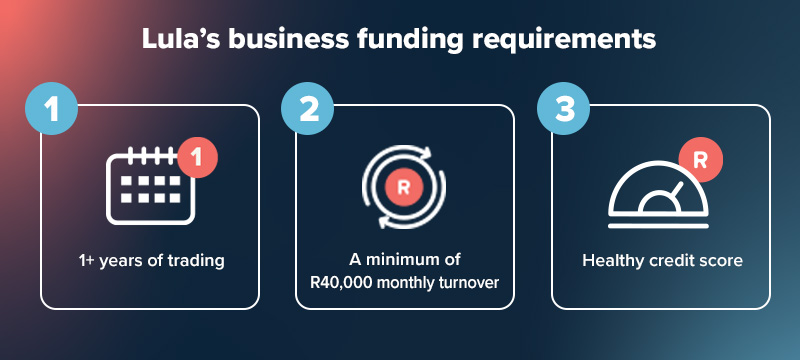
The criteria are straightforward: more than one year of trading, R40,000 in monthly turnover and a healthy credit score for both the business and its directors.
Applications are processed online and funding of up to R5 million can be disbursed within as little as 24 hours.
Two solutions suit different stages of a franchise journey.
Fixed-Term Funding provides a lump sum for a defined cost – fit-out, equipment, initial stock, you name it. Funding is then repaid over a fixed term of three, six, nine or 12 months.
Lula’s Cash Flow Facility works differently: it’s a pre-approved line of funding you draw on as needed, paying only for what you use, with no monthly admin fees.
Once repaid, funds become available again without having to reapply, subject to a credit assessment.
For South African franchise funding purposes, the Cash Flow Facility is particularly well suited to the post-launch period – covering cash flow gaps until the new franchise generates consistent revenue.
Pro: Fast, online application process built around real business revenue
Pro: Two funding solutions cover both upfront capital and ongoing cash flow needs
Con: Maximum funding of R5 million: for large investments, Lula works best as part of a combined funding structure
Con: Not accessible to start-ups
6. Asset and equipment finance
Rather than financing the entire franchise investment as one lump sum, equipment finance lets you isolate specific capital items – kitchen equipment, refrigeration units, POS systems, signage, delivery vehicles – and finance them separately.
This approach keeps your working capital free for operating costs and reduces the total loan amount needed from your primary lender. It’s typically faster to arrange than a full franchise loan and, because the asset itself often serves as security, easier to approve.
Pro: Preserves working capital
Pro: Faster approval than franchise loans
Con: Only covers specific capital items (not franchise fees, working capital or ongoing costs)
Con: Typically higher interest rates than dedicated franchise funding
7. Private investors and angel funding
For experienced business owners, a private investor or angel network can provide equity or structured debt funding outside the conventional lending system. This route works when the deal structure doesn’t fit standard lending criteria or when a conventional lender’s terms aren’t commercially viable.
Attracting capital this way requires a clear pitch: the franchise brand’s track record, your own trading history, projected returns and a defined exit or buyout structure. Without that groundwork, private investor conversations rarely progress.
Pro: Flexible, negotiable deal structures
Pro: Can move quickly once the right opportunity appears
Con: Equity investors take a share of the business
Con: Finding investors requires extensive networking and more time than you’d think
How to Get Working Capital After Day One as a Franchise
Most franchise funding guides you find online stop at the buy-in. But that’s not where your financing needs end.
“The first six to 18 months are the most critical,” says Jonas. “Many franchisees underestimate the lag between opening and generating steady income – cash flows out for rent, salaries and utilities faster than it comes in.”
Royalties and marketing levies are due from month one, calculated on turnover regardless of whether the branch is yet profitable. In addition, if a franchisor-mandated refresh falls in that window (new signage, updated equipment), the capital hit arrives whether you’re ready for it or not.
This is where the right funding structure makes or breaks the post-launch period.
With automatic replenishment and no early repayment penalties, Lula’s Cash Flow Facility is built for cash flow gaps that can arise before a franchise expansion shows consistent revenue, while Lula’s Fixed-Term Funding provides quick capital for that mandatory décor refresh.
Lula’s relationship managers have seen established businesses use funding specifically for this gap. One customer, for example, used Lula funding for their second-store outfitting – covering inventory needs at a new location without disrupting the cash flow of their existing operation.
Take Your Franchise to the Next Level with Lula
Businesses that expand successfully into franchising treat funding as a structured financial decision: the right combination of sources, timed to cover the right cost layers.
For the working capital side of that equation, South African franchise funding options don’t get much more flexible than a facility built around your actual business performance.
Ready to fund your next franchise move? Apply for funding today. Get funded.