Most guides on how to get a business loan in South Africa tell you what documents and numbers you need, then stop.
Almost none explain what happens next and why a seemingly strong application can still fail.
If you’re a small business owner who has experienced this rejection, you’ll know this can cost you in terms of:
– Wasted effort that you’ve put into a lengthy application that you could have invested elsewhere
– Missed business opportunities as criteria built around collateral and credit history ruled you out without anyone looking at how your business operates day to day.
– Time spent puzzling over unclear costs quoted as a rate rather than a clear figure, leaving you unsure whether you could afford the funding.
All are frustrating setbacks for a small business that simply needs capital to progress, but it is possible to avoid them with the right funding tool.
This guide aims to improve your chances of getting business funding by helping you understand what funders assess once you hit submit, and what funding really costs.
We’ll cover:
– What are the Requirements to Get a Business Loan in South Africa?
– How to Apply for a Business Loan Online in South Africa
– How Long Does a Business Loan Take to Get Approved?
– How Much Does Business Funding Actually Cost?
– Types of Business Funding Available to South African SMEs
– Not Sure How to Get a Business Loan in South Africa? Try Lula’s Alternative Funding

What are the Requirements to Get a Business Loan in South Africa?
Any registered South African business that can demonstrate a trading record and sufficient revenue to meet repayments should be eligible for funding, yet many businesses still struggle to access funding.
Over half of business owners have used their personal funds to stay afloat, according to Xero’s State of Small Business Report (2026).
One of the main reasons is that funding stays out of reach thanks to business loan requirements that exclude SME applications based on misleading data.
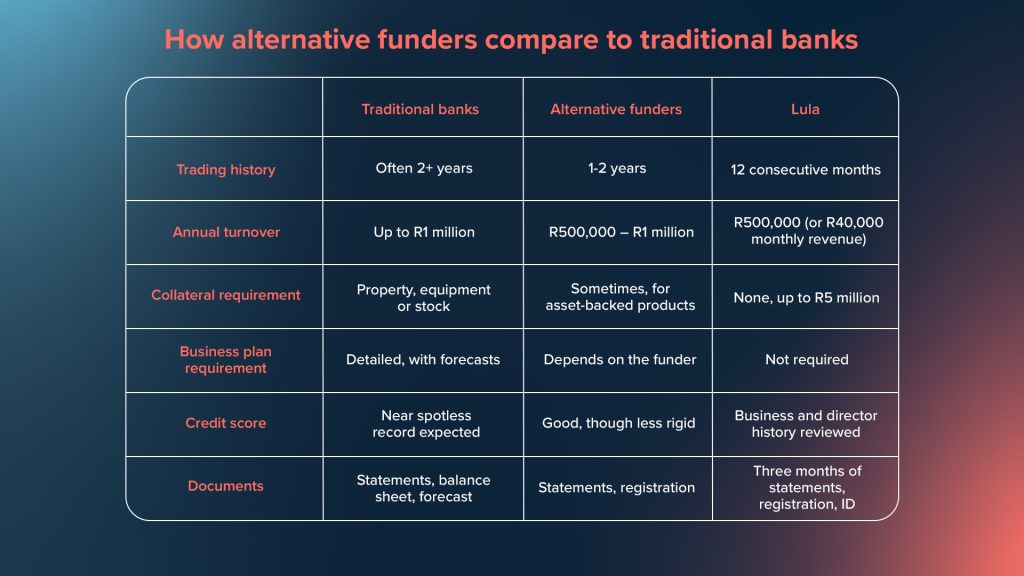
Financial institutions, such as traditional banks, typically ask for the following information:
- A detailed business plan with forecasts
- A balance sheet
- Several months of bank statements
- A robust credit score
- A minimum trading history and turnover
All offer an insight into how the business is set up, but they tend to miss how it is trading right now.
Alternative funding sources, provided they are a registered business funder, work from a shorter list and lean more heavily on how your business is trading in real time.
Some, like Lula, give you the option to link your bank account to see read-only data that shows how money moves through the business week by week: when revenue lands, how it holds up against expenses, and whether trade is seasonal.
You’ll still need to show your credit history, but this is seen alongside your live trading data so that your business is holistically assessed.
How to Apply for a Business Loan Online in South Africa
Sitting down with a bank manager is becoming less common as lenders move their business loan applications online.
Yet the process you need to follow is largely the same as it’s always been. Here it is, broken down step by step.
1. Get your documents together
As mentioned, most banks ask you for a list of bank statements and other financial data that you should have on hand. You often also need the following documents:
- The business director’s ID
- Your CIPC business registration details
- A clear picture of your monthly revenue
- Proof of credit history for both the director and the business.
Alternative funders may ask you for less, but you’ll still need to have the relevant paperwork ready. They should make it clear what this is in their online application requirements.
2. Upload your statements or link your bank data
Most online applications offer two ways to share your trading data. You can upload read-only statements, something that’s typical for larger banks, or you can link your business bank account directly.
Linking is read-only. The funder sees your transaction history but cannot do anything else, such as change details or take money from your account. This process is much faster because the data arrives already structured and takes out the manual reviewing that often slows paper applications down.
3. What happens during assessment
Assessment is where applications succeed or fail, so how the provider handles them is vital.
A bank takes into account your credit score and your assets. This is a reasonable measure of how you have handled credit in the past, but it says little about how your business is trading today.
A digital or alternative funder, meanwhile, reads your transaction data forwards. They see:
– How consistently you generate revenue
– How your cash flow moves through the month
– Whether trade is seasonal
– How deposits behave against expenses
– Whether your business has absorbed a slow patch without falling over.
It means the funder gets a clear picture of what your business is all about.
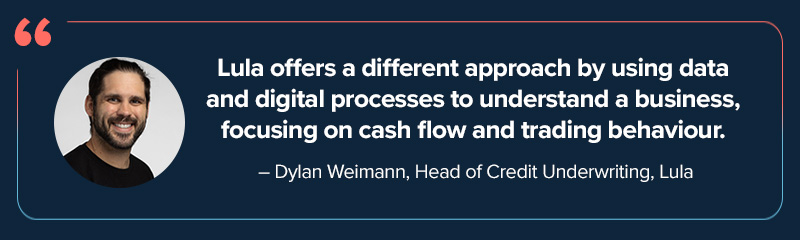
“Traditional funding often lags in speed, flexibility and accessibility for SMEs, which can mean you get harshly rejected after a long wait,” says Dylan Weimann, Head of Credit Underwriting at Lula. “Lula offers a different approach by using data and digital processes to understand a business, focusing on cash flow and trading behaviour, with the objective of getting a meaningful offer to the business owner as fast as possible.”
Put simply, a healthy company with a short borrowing record or no property to pledge can be turned down on history alone with traditional banks. New digital assessment can capture what credit scores tend to miss.
4. Review your quote
If approved, you receive a quote. It should carry no obligation, and you should be able to see the total repayment amount in rands before you accept anything.
Yet you should still check three things:
- The full amount repayable
- The repayment schedule
- What happens if you settle early.
Many businesses trip up because they don’t see hidden costs like early repayment charges or account fees.
Fee-based funding providers are more likely to fix the cost at the outset, and settling early reduces what you pay. With interest-charging products, the figure can change.
5. Payout
Once you accept, the provider should transfer funds to your nominated business bank account, but this might take days with large financial institutions.
Alternative funders are often quicker. Lula’s average approval time is 22 hours because we work with live transaction data instead of a document review queue, so there is simply less to wait for.
How Long Does a Business Loan Take to Get Approved?
Approval times for business finance in South Africa vary, and it often depends on the type of funding you’ve applied for.
For traditional banks, decisions can take several days for a business term loan, or longer if there’s collateral involved. With the back-and-forth of communications, this can drag on for several weeks.
Alternative funders have targeted this gap in the market for faster funding, and many make their decision in a matter of hours instead of days.
Lula assesses applications in minutes. Once accepted, the average approval time is 22 hours. As such, it’s possible for you to complete the whole process in one business day.
How Much Does Business Funding Actually Cost?
Business funding in South Africa may not always be cheap, but it should always be predictable and transparent.
Many providers base their lending on interest rates. They charge interest on your outstanding balance and, because rates move, you’ll never have a guaranteed fixed cost. Throw in the possibility of unclear fees, too, and it’s difficult to plan repayments accurately.
Fixed-fee funding, on the other hand, charges one cost, set upfront. In Lula’s case, you can get an estimate of your repayments before you accept thanks to our business funding calculator. There are no other costs, and settling early reduces what you pay rather than triggering a penalty.
 Let’s take an example of R500,000 funding over 12 months: you see the total repayment amount and the monthly schedule in the quote itself before committing to anything.
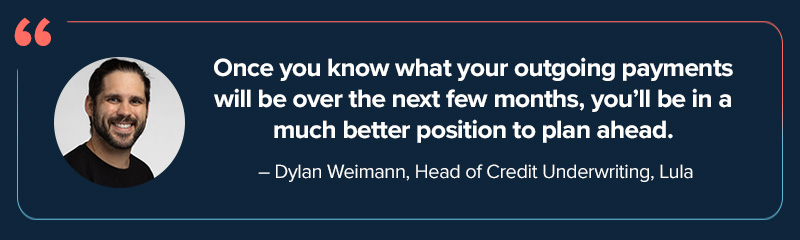
Having this information upfront makes business planning much easier. “Once you know what your outgoing payments will be over the next few months, you’ll be in a much better position to plan ahead,” says Dylan Weimann. “The most successful businesses are those with one eye on the future.”
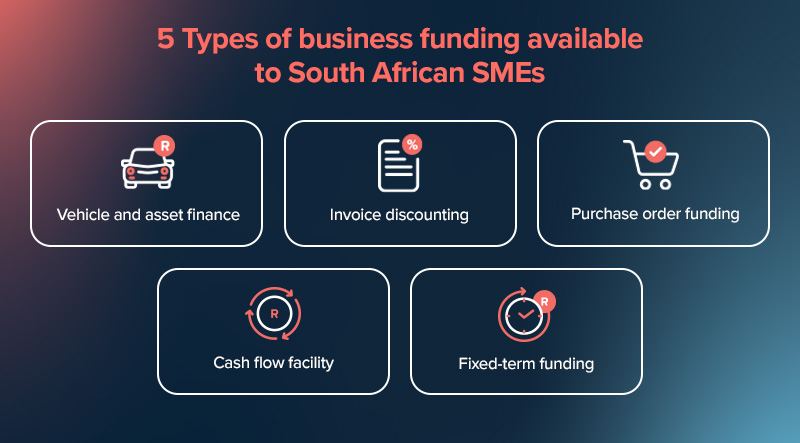
5 Types of Business Funding Available to South African SMEs
Traditional funding is often out of reach for South African small businesses, so many of them fall back on personal loans, which put their household at risk, or angel investors, which mean parting with equity and control.
1. Vehicle and asset finance
If you have equipment or vehicles that you can use as security, then this funding is an option. It’s particularly useful for capital purchases, but the provider can seize the asset if there is a default on repayments.
2. Invoice discounting
This funding releases cash tied up in unpaid invoices, with the provider paying you, then dealing directly with the debtor for the money. Invoice finance, also known as trade finance, suits businesses on long client payment cycles because it converts a 60- or 90-day wait into working capital you can use this week.
3. Purchase order funding
Purchase order funding works in a similar way to invoice finance and covers supplier costs against a confirmed order, so you can fulfil work you have already won.
4. Cash flow facility
Many businesses find these useful because they allow them to draw down working capital on flexible terms. With Lula’s Cash Flow Facility, for example, you can get up to R5 million within a business day, and you only pay for what you use.
5. Fixed-term funding
This is a lump sum that you repay over a set period, with fixed repayment terms. The provider should always set out the relevant fees clearly from the outset.
Not Sure How to Get a Business Loan in South Africa? Try Lula’s Alternative Funding
Business finance loans play an important role in South Africa’s commercial sector, but there’s still a gap between SMEs’ funding needs and the actual funding available.
Often, even if they do qualify, owners must wait for far too long to actually get the money, which can mean they miss out on business growth opportunities.
Lula’s funding solutions were built to fill this gap.
Our application process is fully online, and it takes us minutes to gain a clear picture of your whole business instead of just a credit score, once all required documents are submitted. Healthy trading counts even when your credit file is thin, and the cost is one fee, agreed upfront, with nothing added later and no penalty for settling early. You also get a named account manager who knows your business, rather than a call queue.
“It’s people dealing with people. It’s not computers dealing with statistics,” says Marie-Louise of Anthony Anti-Corrosion Coatings, whose funding covered a full build, new equipment and a bigger workforce.
To qualify you need one consecutive year of trading, R40,000 monthly revenue, and a business registered in South Africa with a South African bank account.
We have grown over 25,000 businesses with R13 billion in funding, R2.8 billion of it paid out in 2025, and our 2025 customer satisfaction score closed at 85%.
Explore Lula’s funding solutions and back your next move.