
If you’ve ever opened your banking app and thought, “We’re fine for now,” only to be scrambling for cash weeks later, you’re not alone.
Most South African small business owners face the same three cash flow traps. You may recognise them as the following:
• Your income looks good on paper, but payments arrive late and mess up your cash flow.
• Your expenses don’t match your busy and quiet periods.
• Surprise costs wipe out your cash balance safety net.
Following a cash flow forecast template can change that.
Simple, organised and easy to create, a cash flow forecast gives you a clear, month-by-month view of your incoming and outgoing cash payments – so you can spot trouble early, plan for seasonal changes, and make smarter growth moves.
In this guide, we’ll show you exactly how to use a cash flow forecast template, step by step, to keep your business running smoothly. Plus, you’ll get a free Lula version you can download and start using today.
| Download our free cash flow forecast template that will help you plan ahead and keep your business running smoothly – no spreadsheet skills required. |
What is a Cash Flow Forecast
A cash flow forecast is a projection of how much money will flow in and out of your business over a specific period – usually the next 12 months.
You may think that this is just a financial exercise for accountants, but it’s a real-world planning tool that helps you answer questions like:
• Will I have enough to cover salaries next month?
• Can I afford to take on that big order without running short?
• How much room do I have to invest in growth?
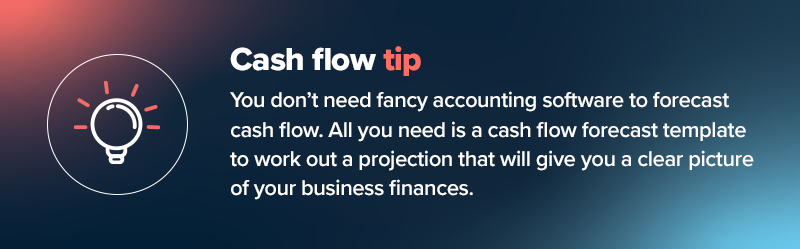
You don’t need fancy accounting software, either (although it can help): you can use a cash flow forecast template to put together a simple projection that will give you a much clearer picture of your business finances.
Why it matters
Running a business in South Africa can be unpredictable. There are plenty of surprise expenditures that can arise and hit your cash flow hard.
Economic shifts can cause sales to swing unpredictably, so that it’s harder to rely on last month’s numbers as a guide.
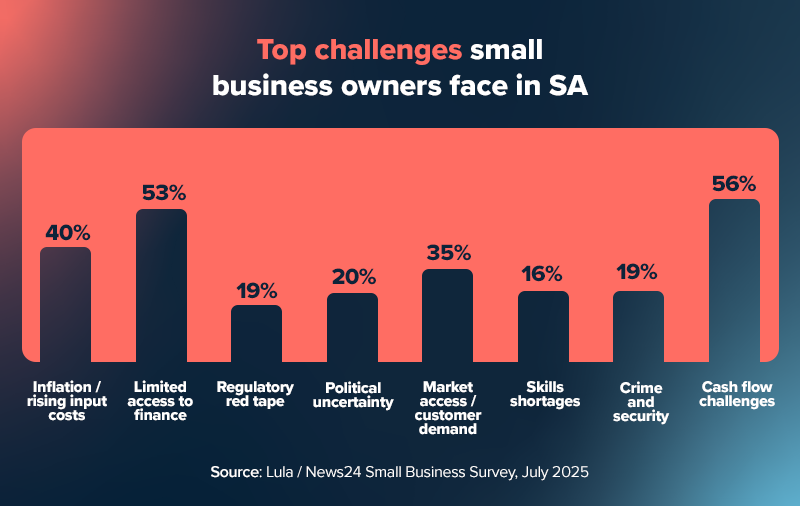
In our Lula Small Business Survey we conducted with 815 SME owners, in partnership with Media24, cash flow emerged as the top concern. 56% of respondents identified cash flow as their biggest issue. This was followed by other major challenges like limited access to finance, inflation and rising costs.
Inflation, while under control at the time of writing, can fluctuate and push supplier costs up while customers tighten their spending, leaving you with less room to absorb price changes.
And when the gap between income and expenses grows, access to quick business funding isn’t always straightforward – especially if you’re scrambling in the middle of a cash shortfall.
Cash flow assistance is one of the most requested types of small business funding after start-ups and business expansion, according to the South African MSME Access to Finance 2025 report.
That’s why a clear cash flow forecast is so important. It acts as an early warning system that helps you spot trouble ahead and prepare for it before it hits.
If you do need funding, then having a detailed cash flow projection will improve your chances of getting it.
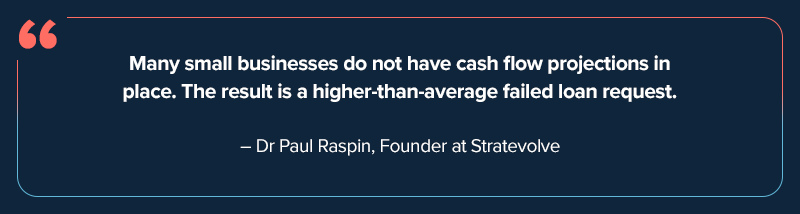
“Many small businesses do not have cash flow projections in place, which is the type of information and planning that banks like to see to secure credit,” says Dr Paul Raspin, founder of consulting firm Stratevolve, speaking to Forbes. “The result is a higher-than-average failed loan request, or higher interest rates to compensate for the bank’s perceived risk.”
How a Cash Flow Projection Works
Think of your projection as a financial weather forecast. It shows you sunny months with surplus cash and stormy months where you may need an umbrella (or a funding plan).
It’s made up of three parts:
1. Cash inflows
These represent money coming in from:
• sales of products or services;
• loan disbursements;
• investment capital; and
• other income (e.g. asset sales).
2. Cash outflows
These represent money going out for:
• rent and utilities;
• salaries and wages;
• supplier payments;
• loan repayments; and
• tax obligations.
3. Net cash flow
This is simply the difference between inflows and outflows for each period and can be a surplus (positive cash flow) or a shortfall (negative cash flow).
If a shortfall is on the cards, you can see exactly where cash gaps might occur by assessing each expense or income item.
In the next section, we’ll look at a cash flow sheet example you can follow to see these future cash flows more clearly.

How to Create a Cash Flow Forecast in Steps
Even if you’re not a numbers person, a simple cash flow forecast can give you clarity and control over your money.
Here’s an example of a cash flow forecast template that you can follow.
Step 1: Choose your time frame
Decide how far ahead you want to forecast.
For most South African small businesses, a monthly cash flow forecast for the next 12 months is the sweet spot as it’s detailed enough to plan ahead without feeling overwhelming.
Short-term businesses or start-ups may also want to track on a weekly basis at first, especially if working capital is tight.
Step 2: Gather your data
If you’ve been operating for a while, pull figures from previous years, like sales reports, expense records, and cash flow statements. The more accurate your past data, the more reliable your forecast will be.
New businesses? Use reasonable sales estimates from your business plan and include all fixed costs you already know about, like rent, salaries and insurance.
Step 3: List all expected inflows
As you can see above, inflows aren’t just sales – they include cash payments, retainer contracts, grants or a business loan you’re expecting to land.
Break them down by customer, project or revenue stream so you can track where your cash position is strongest. This also makes it easier to see if you’re relying too heavily on one source.
Step 4: List all expected outflows
As well as rent and salaries, factor in loan repayments, seasonal expenses like annual bonuses, tax bills, or period of time-specific costs such as stock purchases before busy seasons.
Be realistic here: overestimating your liquidity can lead to nasty surprises later.
Step 5: Calculate your net cash flow
For each month, subtract your total outflows from total inflows.
A positive figure means you have enough cash to cover expenses and possibly reinvest; a negative number means you’ll need to take action, such as cutting costs, boosting sales or securing funding.
This running total becomes your closing balance, which then becomes the opening balance for the next month.
Step 6: Review and adjust regularly
Your forecast shouldn’t be a “set-and-forget” document.
Savvy business owners check it on a monthly basis to compare their projections with real results. If a future month shows a shortfall, then plan early and try and think of a way to make up for it. Common ideas include:
• delaying non-essential spend;
• running a promotion to boost income;
• arranging extra funding; and
• negotiating payment terms with suppliers or customers.
Think of it as a real-time cash flow management dashboard that keeps your business in the clear.
Common mistakes to avoid when putting together your statement
Even with the right tools, small business owners often trip up when forecasting their cash flow. Here are some of the most common errors.
• Being too optimistic about sales: It’s safer to underestimate income than to be caught short.
• Forgetting seasonal expenses: Holidays, bonuses and annual renewals can drain cash quickly.
• Not updating regularly: A projection is a real-time document. Update it monthly to stay on track.
• Ignoring small leaks: Even small recurring costs add up and can push you into a cash shortfall.
Avoid these pitfalls to turn your cash flow forecast into a practical guide for decision-making, rather than just another spreadsheet gathering dust.
How to Keep a Cash Flow Projection Updated
A cash flow forecast is only as good as the numbers it’s built on. That’s why your projection should be a living document, not something you create once and file away.
At the end of each month, compare your actual inflows and outflows with your forecast. Use your weekly cash flow forecast template to spot any differences quickly.
If your sales dipped or expenses rose, update future months so your forecast reflects reality. You can also revisit your plan when market conditions shift – let’s say there’s a spike in supplier costs or a sudden drop in demand.
Over time, this habit will help you develop sharper projections, as you get to fine-tune your projection based on real-world results.
How to Turn Insights into Opportunities
Even with the most accurate projection, cash flow gaps can still happen, especially if your business is growing or working with long payment cycles.
The benefit of maintaining a detailed cash flow forecast template on Excel (or a similar programme) is that it warns you in advance. You’ll know when a shortfall might occur and how much you’ll need to bridge the gap.
That’s when you can line up short-term funding to cover seasonal dips. You’ll also avoid scrambling for a last-minute business loan at unfavourable terms.
Lula’s business funding solutions, like our Cash Flow Facility and Fixed-Term Funding, are designed for South African small businesses, offering fast-tracked approvals, flexible repayment options and transparent costs – so you can keep your working capital healthy without disrupting your plans.
Take Control of Your Cash Flow with Lula
A strong cash flow projection goes beyond being a part of your business financial planning year-end checklist; it can even be a foundation for confident growth.
With Lula’s free cash flow projection template you can:
- spot issues before they become crises;
- make informed spending decisions backed by solid numbers; and
- plan for growth without the panic.
Lula gives you the tools and support to manage your liquidity in real-time. That means no more guessing if you’ll have enough cash at month’s end and more time to focus on building the business you want.
Download your free Lula Cash Flow Projection Template now and take the first step to a smoother, more predictable business future.