
Running a transport operation means you’re great at keeping everything on schedule – except, perhaps, the funding you need to keep the business moving.
The problem is that securing funding for a transport business in South Africa often involves endless waiting, even when your vehicles and staff can’t afford a single day of downtime.
You might be moving goods across Limpopo, running passenger routes in Cape Town or scaling a logistics fleet in Gauteng – either way, the industry never slows down.
Your vehicles need maintenance now, contracts need financing now and fuel needs paying for now.
Yet traditional lenders operate on their own clock, with long processes and strict requirements, while your transport business must run at real-world speed.
Thankfully, some types of funding for transport businesses in South Africa can help you flip that, so you can keep your fleet on the road, your contracts fulfilled and your cash flow steady.
How Much Does it Cost to Start a Transportation Service?
You know that starting a transport business in South Africa isn’t cheap.
Your biggest expense is often the vehicle itself.
Beyond the vehicle, you have additional expenses like:
- licensing;
- permits;
- insurance;
- fuel;
- driver wages;
- routine maintenance; and
- compliance checks, especially important if you operate multiple routes.
Cash flow is another factor. There may be instances where you wait 30 to 90 days for payment, so a working capital buffer is a must-have if you want to keep things running between payments.
Passenger transport tends to have lower vehicle costs but stricter regulatory requirements, including compliance with Operating Licence requirements under the National Land Transport Act (NLTA).
A trucking business in South Africa, on the other hand, carries heavier upfront expenses but usually earns more per kilometre.
Freight rates commonly range from around R12.50 to R25.00 per kilometre for heavier loads, according to UrgentGo Courier, which translates into higher earning potential than for smaller cargo amounts.
Most new operators need enough capital to cover the vehicle purchase and at least three months of running costs.
The 7 Best Types of Funding for Transport Businesses in South Africa
Finding funding for a transport business in South Africa can be difficult.
The good news is that transport owners have more options than they often realise.
From SEFA (Small Enterprise Finance Agency) and SEDA (Small Enterprise Development Agency) to private investors and fast alternative SME lenders, each option supports a different stage of growth.
Below is a clear breakdown of the seven funding types that work best for transport businesses, whether you’re trying to work out how to buy a franchise or simply expanding your routes.
1. SEFA funding
SEFA is a viable funding route for businesses that struggle to access commercial credit, including those from minority groups, such as black-owned transport businesses.
SEFA’s CEO notes that the agency disbursed R14.5 billion to more than 629,000 small businesses and cooperatives nationwide in its first decade, showing the scale of support available.
They offer loans, asset finance and working capital, but they are quite selective.
To qualify, you’ll need at least a year of trading, a turnover above R500,000 and solid B-BBEE credentials.
SEFA works well for operators with steady routes and predictable demand. If your business already services contracted clients or supply-chain partners, your chances improve.
It’s a government-backed lender, so the rates can be fair, but the challenge is the process. Applications move slowly, and the paperwork can feel heavy, especially if your financial records aren’t organised.
Top tip
Show SEFA you’re not a risk. Add signed transport contracts or letters of intent to your application. Evidence of committed work carries real weight during the assessment.

2. SEDA grants and support
SEDA isn’t a direct lender, but they can provide funding via grants.
Their non-financial support also helps transport business owners looking for guidance before applying for funding elsewhere. They offer advisory sessions and training aimed at improving operations, compliance and day-to-day planning.
This option suits smaller transport businesses or owners branching into new logistics routes.
If you’re trying to tighten your business plan or streamline costs before applying to SEFA, IDC (Industrial Development Corporation) or private investors, SEDA can help get you ready. Their team responds well to businesses that arrive prepared and that understand their cost drivers.
Top tip
Walk in with a complete business plan; include route maps, fuel projections, maintenance schedules and cash flow patterns. The more clarity you bring, the faster SEDA can guide your next steps.
3. IDC transport finance
The Industrial Development Corporation backs transport businesses that contribute to economic growth and job creation.
Their funding suits operators planning to scale beyond a small fleet or expand into cross-border or specialised logistics work.
The IDC looks for businesses that strengthen local supply chains and support development in regions like the Eastern Cape or Limpopo.
This option works best if your growth plan has a real economic impact. They want to see how your expansion will support local employment and stimulate productivity in the surrounding industries.
The funding amounts can be substantial, but expect a careful assessment process. IDC is thorough, especially with large-ticket financing.
Top tip
Make sure you emphasise the social and economic value of your project, including the creation of more jobs and new routes in underserved areas, to strengthen your application.
4. Private investors and transport partnerships
If you’re looking for a large capital injection without taking on heavy debt, then private investment could be the answer.
Many businesses take on investors as partners as they grow.
This can help them expand their fleets and add new service lines – or even jump from a small proprietary (Pty) to a more specialised transport operation.
Investors generally move faster than institutional lenders and they gravitate towards sectors with steady demand, transport included.
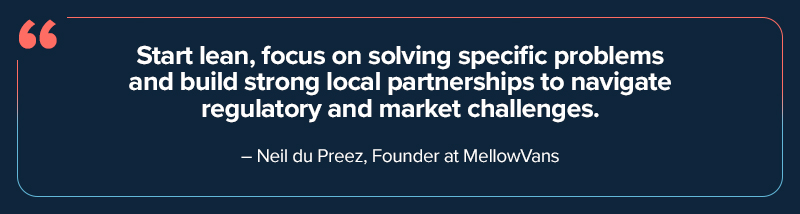
As Neil du Preez, founder of EV delivery firm MellowVans, said in an interview with Forbes Africa: “Start lean, focus on solving specific problems and build strong local partnerships to navigate regulatory and market challenges.”
The key is clarity. Investors want to understand how their capital will grow your revenue and how quickly you can deliver returns. They don’t need a long pitch deck, but rather confidence in your numbers, routes, margins and operational discipline.
Top tip
A short, clear proposal for funding your transport business in South Africa will go a long way with lenders. Show profit per vehicle and how long it will take them to recover their investment. This is simple maths, but it builds trust and speeds up decision-making.
5. Traditional asset finance for trucks and vehicles
Traditional bank-backed asset or equipment finance may be a familiar path if you want to buy newer trucks, bakkies or specialised vehicles. The South African MSME Access to Finance Report 2025 released by Finfind in partnership with African Bank shows that buying equipment is the number-one funding request among SMEs, accounting for 21% of all applications.

If you’re new to this concept and you’re wondering ‘What is equipment finance?’, then put simply, it’s a loan that lets you buy a vehicle or piece of equipment and pay it off over time while you use it to generate income.
Alternative facilities usually come with competitive repayment costs, which helps with long-term repayment planning. They work best when the vehicle generates predictable income, such as contracted routes or consistent load demand.
The downside is the stringent requirements and lack of flexibility. Banks expect strong credit records, steady turnover and clean financial statements.
Approval can take time, especially if the lender wants additional documents or updated statements. For established businesses with stable revenue, however, it’s still a reliable option.
Top tip
Pick vehicles with strong resale value. Lenders view them as lower-risk assets, which can improve your chances of approval and lead to more favourable terms.

6. Franchise funding
Thinking of building a new transport franchise? Watch out: doing this too quickly and without finance is one of the biggest business mistakes you can make.
Many franchisors and external lenders offer funding for this process, which offers a structured way for your business to expand.
This approach works especially well for owners entering new segments, whether that’s courier services or specialised logistics routes. The built-in support, brand recognition and existing systems help reduce the early operational challenges that come with it.
Funders like franchise models because the numbers are predictable. They can assess performance across existing branches, which makes the risk easier to calculate. Your role is to show you can run the operation effectively and meet the brand’s required standards.
Top tip
Bring verified franchise financials to your application meeting. Historic performance data makes lenders far more confident and can speed up approval times.
7. Alternative small business funding
Alternative SME funding has become a practical option for transport businesses that can’t wait for lengthy bank reviews or complicated application processes.
These lenders look at your actual trading activity, not just a balance sheet or credit score, which makes them far more accessible to small businesses, including those in the transport sector and logistics business space.
This type of business funding works well when you need quick support for fuel, maintenance, tyres or unexpected repairs.
Many operators also use it to cover cash flow gaps caused by long customer payment terms.
Because alternative lenders move faster than traditional institutions, funding often arrives in time to prevent operational delays and protect your routes.
Alternative lenders like Lula, for example, provide fast working capital finance for established transport businesses that need to make decisions in days, not months.
Top tip
Use alternative funding to stabilise short-term cash flow. It helps keep your vehicles on the road even when invoices take time to clear.
How to Get Funding for a Transport Business in South Africa
Securing funding becomes far easier when you approach it in a clear, organised way.
Here’s a straightforward process that works for most transport businesses, whether you’re running a small fleet or expanding into new routes in the transport sector.
1. Get your documents together
If you don’t know already, learn how to write a business plan, then add it to your stack of relevant documents, including six to 12 months of bank statements, permits and a recent balance sheet. Most funders will ask for these before they even look at your application form.
2. Decide which funding type fits your operation
Match the funding option to your actual need: a new automotive asset, working capital or longer-term growth. Your fleet size, route structure and cash flow patterns will guide your choice here.
3. Map your cash flow cycles
You already know how fuel, wages and maintenance shift from week to week, but you’ll need to fully understand these cycles so you can choose funding that supports stability and sustainability.
4. Prepare a simple funding proposal
Keep it specific: what you need, why you need it and how it improves your position in the value chain. Funders appreciate clarity and straightforward reasoning.
5. Apply to more than one source
Submitting two or three applications improves your chances of approval and speeds up the process. Different funders support different entrepreneurship initiatives, so widen the pool.
6. Add working capital to your strategy
Even profitable entrepreneurs run into timing issues. Working capital finance helps you keep operations moving while you wait for invoice payments.
7. Use alternative lenders for long payment terms
If customers pay late, alternative SME funders can fill the gap. They’re often faster than traditional lenders and better suited to fast-moving transport operations in the South African economy.
Need Fast Funding to Grow Your Transport Business?
Transport businesses move quickly, but funding often doesn’t. Vehicle maintenance can’t wait; fuel costs shift daily. Clients pay on long terms and routes expand faster than cash flow.
Most transport operators eventually reach a point where the work is there, but the capital isn’t.
This is where fast, flexible funding becomes essential. The right support helps you take on new contracts and keep your fleet running – it also lets you manage the unpredictable costs that come with transport work.
Fixed-term loans, working-capital facilities and short-term operational funding all play a role in keeping a growing business stable.
Many South African transport SMEs are turning to Lula because our finance is built with them in mind.
Our Fixed-Term Funding provides a once-off capital boost for expansions or higher upfront costs.
Our Lula Cash Flow Facility, meanwhile, gives you flexible access to funds when cash flow tightens, making it easier to manage fuel, repairs and long payment cycles.
Both options come with transparent pricing and fast decisions, so you feel confident to move when the opportunity arrives.
Get the financial control you need to keep every route running smoothly with Lula.
Ready to grow your fleet or expand your routes? Apply online in minutes today and get funding built for transport businesses in South Africa.