Venture capital in South Africa tends to grab the headlines with its big cheques and TED Talk energy.
Yet, despite all the fanfare, it may not be the best way to fund the next move for most established small business owners. If you find yourself searching ‘venture capital South Africa’, there are a few important considerations before making a decision.
Often, it’s not clear what VC actually involves and how to qualify for it – and it often comes with hidden difficulties that business loans don’t typically have.
This article breaks down how venture capital and business loans actually compare in the South African context, so business owners can decide based on their specific circumstances, rather than just the hype.
– What Does Venture Capital in South Africa Actually Involve?
– What Does a Business Loan for South African SMEs Look Like?
– Venture Capital vs Business Loans — The Comparison That Actually Matters
– When Venture Capital Makes Sense
– When a Business Loan Is the Smarter Call
– How to Make the Right Call for Your Business
Venture capital funding isn’t the only way to grow your business. Apply now with Lula and find out how we can partner with you on your business scaling journey.
What Does Venture Capital in South Africa Actually Involve?
Venture capital in South Africa works in the same way as in any other country – a venture capital firm or funder injects capital into your business in exchange for a stake in it.
This stake could be built around a share of future profits and a say in major decisions, often via a seat on the board.
The South African venture capital ecosystem is concentrated in a few key areas, including Johannesburg and Cape Town. These hubs host a thriving network of active venture capital funds and angel investors, with some reaching into broader Southern Africa.
Business venture capital plays a central role in start-up funding in South Africa, which makes up one of the continent’s “Big Four” nations that collectively account for 84% of African funding. It can appear in the form of seed funding and other early-stage investment vehicles, as well as growth funds for established businesses.
VC funds typically come from pooled capital raised from institutional investors and high-net-worth individuals and are managed by fund managers. This differs from angel investors in South Africa, who are individuals or partnerships investing their own capital at an early stage, and from private equity, which targets more mature businesses needing larger cash injections.
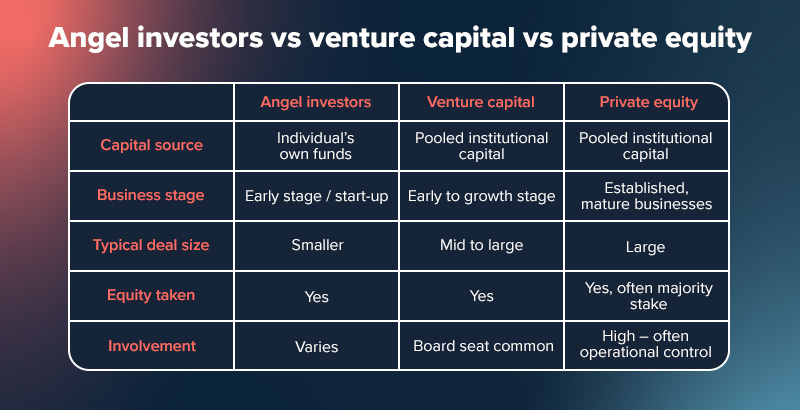
There is one thing that unites this type of funding: a bet on quick growth, particularly VC funds. “VC money is a specific bet on hypergrowth toward an initial public offering (IPO) or large strategic exit,” says Einar Vollset, Founder and Managing Partner of Discretion Capital, a boutique investment bank. “If your business is growing 20–30% annually and generating solid cash flow, VC funding might actually be the wrong tool, because the return expectations will force decisions that destroy what’s already good about the company.
For most established South African SMEs, that profile – a scalable new business targeting global markets with a clear exit path – simply doesn’t apply.
What Does a Business Loan for South African SMEs Look Like?
A business loan gives you access to capital without giving up any equity. You borrow a defined amount, and you repay it over an agreed term, plus fees and (often) interest.
A fixed-term loan like this provides several advantages over VC funding. Costs are fixed from the outset, making it straightforward to plan repayments around your cash flow, and you retain full control of your business.
“A fixed-term loan is less intrusive if cash flow can support it,” says Debra Vanderhoff, founder at Micro Lumix, a bioscience firm. “It works better when expansion is predictable, like adding capacity, equipment or distribution.”
For years, however, traditional business loans have posed an obstacle to growing businesses due to strict lending restrictions and high rejection rates.
Banks have historically required extensive documentation, strong credit histories, and collateral that many small- and medium-sized enterprises (SMEs) lack, leaving viable businesses without the capital they need to grow.
It’s led to a new wave of flexible alternative lenders that are overtaking financial institutions tied up in red tape and excessive paperwork.
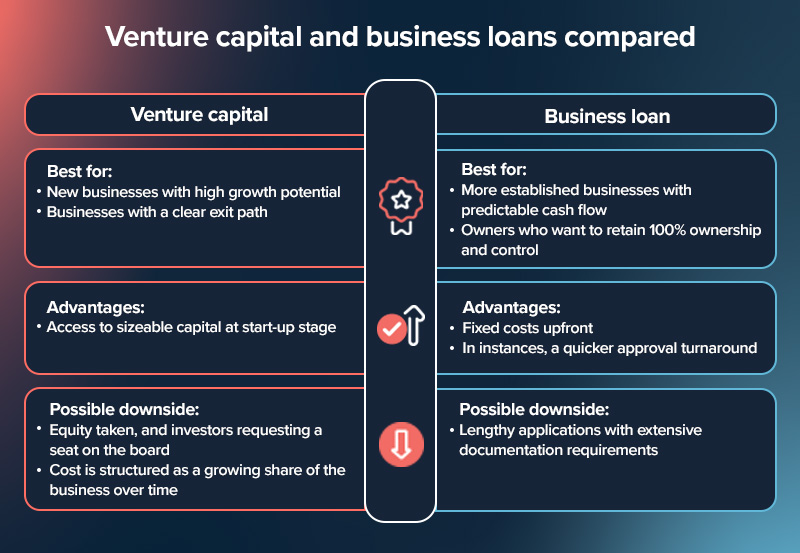
Venture Capital vs. Business Loans: A Comparison
For an established South African SME weighing up its options, the choice between venture capital investment and a business loan comes down to a few fundamental questions:
- How much control are you willing to give up?
- How quickly do you need capital?
- What stage is your business actually at?
The table below maps out the key differences.
When Venture Capital Makes Sense
Venture capital is an excellent option for many businesses, but the conditions must be just right.
If you’re building something category-defining, like a high-growth new venture targeting a global market or a scalable product with the potential to attract significant strategic interest, equity funding could be just the tool you’re looking for.
Be prepared, however, to defend that growth prediction with concrete numbers, such as clean revenue data and documented margins.
You must also be ready to embrace new voices and perspectives, as financial experts partner with you to build a more powerful business.
For entrepreneurs who genuinely want a bigger, faster (and different) enterprise and are willing to share that journey, equity can be a powerful accelerant.
When a Business Loan Is the Smarter Call
If your business has a specific, near-term use for capital, such as hiring staff or covering expenses, then a business loan is likely the cleaner tool.
For most businesses, this need for fast and flexible capital is real, and can be the growth lever that propels them to the next stage. Transformation isn’t the goal here, but steady momentum.
Your entrepreneurship journey, your decisions, your upside – all of it stays with you. A business loan should fund this momentum without asking anything in return beyond repayment, yet many funding options fall short of these requirements.
Choosing the right business loan can make a huge difference to your business’s fortunes, but it’s not always easy to do it in a crowded and often confusing market.

How to Choose the Right Funding for Your Business
A business loan is the more realistic solution for the vast majority of established South African SMEs, but with an increasing number of providers opening up shop and offering competitive products, deciding which is right for your company matters as much as what type of funding you need.
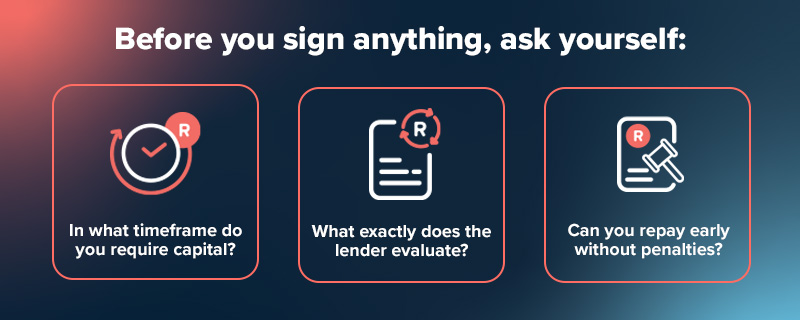
Before you sign anything, it may be worth asking the following questions:
In what timeframe do you require that capital? If speed is everything, choose a lender who will evaluate your application, approve it and send you money within 24 hours of approval — a world apart from the months-long fundraising process that accompanies an equity fund.
What exactly does the lender evaluate? A credible provider will look at track record and potential, as well as bank statements and business credit score. This will help them build a true picture of your business and lend more responsibly.
What are the total costs, and are they fixed? Look for transparent, fixed fees with no hidden charges. If a lender can’t give you a clear answer upfront, that’s a red flag.
Can you repay early without penalties? High-growth periods can free up cash quickly. A lender that allows early repayment means you save on fees when your business is performing well.
Manyene Holdings (Pty) is one success story that showed how choosing the right SME funding in South Africa can have a transformative effect. Frustrated by slow, expensive financial services from banks, co-owners Theresa Ward and Edwina Butterworth turned to Lula.
“With Lula, the process for application was extremely easy, and within a couple of hours we were approved,” say Butterworth and Ward, who used the funding to get ahead of orders. “Just procuring the stock ahead of time has made a huge difference, and has helped us grow from two people to 50 employees.”

Having the right capital available at the right time has been the most important factor for Manyene Holdings, allowing it to scale on its own terms.
Venture funding has its place. But for most established South African SMEs, the smarter move is to keep what you’ve built and use the right funding to build more of it.
Ready to discover how Lula can help you grow your business? Apply now and access the growth funding you need within 24 hours.