
If you’re in construction, managing cash flow is one of the biggest challenges you’ll face.
Money rarely moves in and out of a project at the same time. This is precisely why a construction project budget needs to do more than show totals. It needs to show when cash flows in and out of your bank account.
A good construction budget is less about determining the final profit and more about whether the project’s financial health can withstand the early cash flow strain. Without a clearly defined construction budget plan, this early timing mismatch is often underestimated or ignored.
Most construction projects start cash-negative. Labour costs, materials and equipment upgrades can quickly stack up, long before invoices are settled. This creates a time gap at the start of a project.
You might be required to pay suppliers within 14 days, cover labour costs for the first few weeks, and place deposits on equipment during mobilisation. Yet, your first incoming payment could still be 30, 45 or even 60 days away.
On paper, the project looks profitable. In reality, your bank account is under pressure from day one. This gap between early expenses and delayed income is where many projects begin to take strain.
A strategic financial plan that accounts for this early financial pressure can get you ahead and allow you to take on more projects with less strain.

What is a Construction Budget?
A construction budget is a list of income and expenses for a specific project.
However, a detailed construction budget is more than just a list of income and expenses; it is a comprehensive road map that can help you track all income and expenses, from inception to completion, throughout the entire timeline of a project.
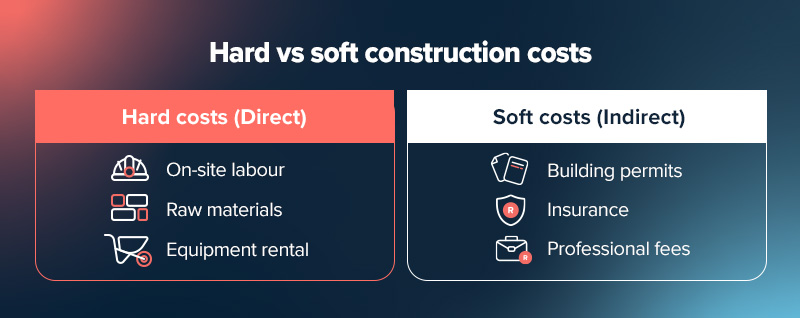
It should include both direct costs (hard costs), such as labour and materials, and indirect costs (soft costs) like permits, insurance and other fees, which are usually due before construction begins.
The hidden cash flow problem behind ‘profitable’ projects
One of the biggest challenges with traditional construction budgets is that they only focus on totals – the overall project cost and the gross profit. These figures are important, but they miss a big part of the puzzle.
A budget may show a healthy profit on paper, but there may still be a strain on cash flow, especially early in the life cycle of a project when expenses are leaking out long before any income flows to your bank account.
Why timing matters more than totals in construction budgets
A comprehensive construction budget needs to account for when income and expenses actually move. It’s not enough to know what you need to pay suppliers; you need to know when those payments fall due.
Likewise, it’s not just about how much material is required, but rather when it must be ordered, delivered and paid for.
This is why timing needs to be treated as a core pillar of any construction budget, not a secondary consideration. Without a clear view of timing, even an accurately priced project can create avoidable cash pressure and unexpected budget overruns.
Early-stage costs stack up faster than most budgets assume
It’s possible to get the overall income and expense figures correct, but still run into cash flow problems. In theory, the numbers may show a healthy profit on paper.
In reality, your bank account can tell a different story when early-stage costs start racking up. This is why managing cash flow is key, especially early on when the outflow of money exceeds the inflow.
Understanding the ‘S-Curve’ Reality in Your Construction Budget
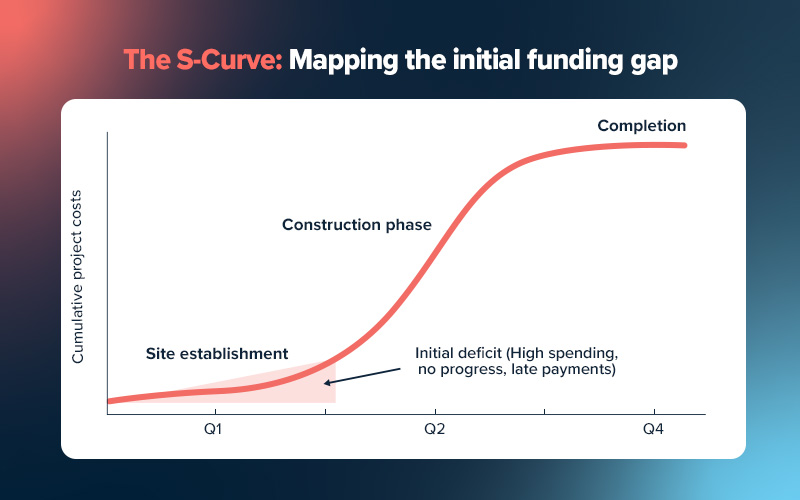
In the construction industry, spending follows a fairly predictable pattern called the S-curve.
Spending starts slowly during the beginning or preparation phase, then ramps up substantially during the middle period as work intensifies, and eventually tapers off as the project nears completion. If you plot your cumulative costs against time, you’ll see an S-shaped curve.
Why the S-curve creates a predictable funding gap
The problem is that the income from your project doesn’t follow the same S-curve as your expenses. Income is usually paid in smaller streams based on payment schedules, invoicing cycles and the amount of work completed on a project.
For project managers, this disconnect is where budgeting assumptions often break down. The S-curve makes it easy to underestimate how quickly cash demands accelerate once a project moves beyond mobilisation.
Labour hours increase, material deliveries become more frequent, and subcontractor invoices start stacking up.
Meanwhile, income lags behind progress on site, especially where certification, inspections or approval processes delay invoicing.
Mobilisation is where cash pressure peaks
This pressure is most visible during the beginning phases of a project. In a perfect world, you get paid first, then pay your obligations. But that’s not how a construction project works in the real world.
There’s always a gap between the income and expense curves, and this gap represents your funding need. However, this gap is predictable, which means it can be planned for long before it becomes a problem.
Understanding this S-curve can transform how you approach your project budget. Instead of just asking, “Will this project be profitable?”, you start thinking about other questions like “Can we fund the gap between spending and income?” Both questions matter. You can’t take on a project (no matter how profitable) if you simply don’t have the cash required to make it work.
How to Create a Budget for a Construction Project
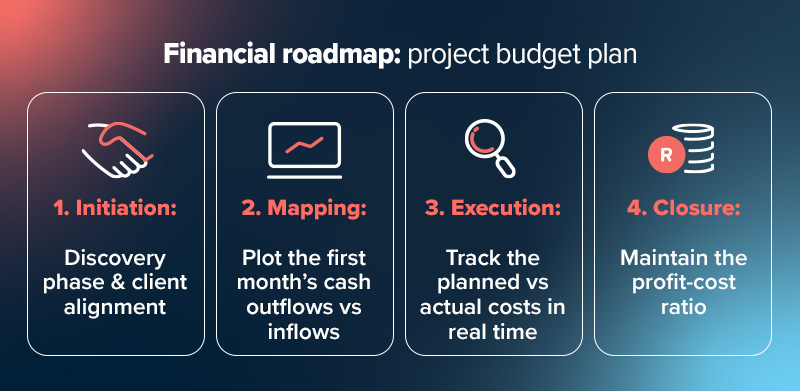
Creating a construction budget is about more than listing income and expenses. It’s about understanding how money flows through a project over time, and planning for times of deficit, where expenses run ahead of income.
A well-structured budget is the foundation of a construction budget plan. A budget tells you what a project will earn and cost. But a budget plan goes further, and accounts for when the money moves. Both are essential to managing cash flow effectively.
Here’s how you can draft a clear construction budget plan:
Step 1: Break the project into phases
Start by splitting your project into several phases:
- Mobilisation
- Foundation
- Structure
- Completion
Each phase has unique financial demands, and simply grouping them together doesn’t account for the different financial needs at each stage of the project.
Step 2: Budget income and expenses for each phase
Once you’ve broken down the phases of your project, note the projected income and expenses for each of the four phases.
Expenses may include the following:
- Labour costs
- Material purchases
- Equipment hire or deposits
- Subcontractor payments
This is where the picture becomes clearer. You’ll be able to clearly identify projected income and expenses for each stage of the project.
Step 3: Identify the funding gaps beforehand
Using a phased approach like this helps you spot the funding gaps. For example, you may estimate that you’ll need to spend R50,000 during the mobilisation phase, but project that you’ll receive no income during this phase. This pinpoints a R50,000 funding gap for phase 1.
Likewise, in phase 2, you may project a R20,000 deficit, which represents a R20,000 funding gap for this phase.
Identifying these funding gaps beforehand makes all the difference, and you can arrange funding ahead of time.
Step 4: Stress-test your assumptions
When creating your construction budget plan, use conservative assumptions.
If a customer usually pays in 45 days, plan for 60. If suppliers normally require payment in 14 days, plan for 10. A more conservative approach is smart. It’s better to plan for the worst and be prepared than hope for the best.
Step 5: Button down your budget plan
Once you have all the income and expenses written down for each phase of the project and have identified any spending gaps, you need a plan in place to cover these gaps.
Will you use alternative funding to cover these funding gaps? If so, how much do you need and when do you need it by? These aspects all need to be accounted for in a detailed budget plan. Arrange funding in advance, so you are not scrambling at the last minute.
Stop guessing your cash flow, and start scaling your projects. Learn more about our Lula Cash Flow Facility.
Developing a Resilient Construction Budget Plan
A resilient construction budget plan should separate your costs into clear categories, account for unexpected costs, and include a plan to cover periods of limited cash flow.
At its core, a resilient construction budget plan recognises that cash availability matters just as much as total project cost.
Break your costs into three main groups: hard costs, soft costs, and contingency.
Hard costs
Hard costs are the tangible construction costs of a project. They include material costs, labour costs, equipment hire and subcontractors.
These are costs that directly impact the creation of the finished project. Material and labour costs can fluctuate, so it’s wise to lock in quotes and pricing as early as possible.
Also included are equipment costs, which can easily run higher than expected.
It’s not just the daily rental rate, but also delivery costs and operator expenses. If you’re hiring subcontractors, consider that most will require a deposit upfront, before they begin work.
Soft costs
Although soft costs aren’t part of the physical construction, they are essential to making the project possible. Permits, insurance, design fees, engineering, inspections, legal costs and financing expenses all fall into this category.
Many soft costs hit early in the project timeline and must be paid before construction can begin. A project may look profitable on paper until these costs are factored in, which is why tracking them from the outset is important.
Contingency buffer
A construction project almost never goes exactly as planned. Material prices change, weather causes delays, and scope adjustments happen mid-project.
Because uncertainty is unavoidable, planning for unforeseen costs is essential. The most effective way to do this is by building in a contingency buffer – an allowance for expenses you can’t fully predict upfront.
Industry standards suggest a contingency buffer of around 10% to 15%, depending on project complexity, size and your experience with similar projects.
Why contingency protects cash flow, not just margins
The recommended 10% to 15% as a contingency buffer isn’t arbitrary. It’s a strategic financial strategy to absorb those small, cumulative financial hits that rarely justify a formal variation from your budget, but still affect your cash position.
These financial pressures can come from a variety of sources, like delivery delays, material substitution or weather delays extending the project timeline.
Individually, these hiccups may seem manageable. Collectively, they can erode margins and strain cash flow if no buffer has been built in. A properly sized contingency buffer helps keep the project moving without constant financial firefighting.

Advanced Construction Budget Tracking: Moving Beyond the Spreadsheet
When tracking income and expenses, most construction businesses start with spreadsheets. For small operations, this can work, but it quickly becomes limiting as projects grow.
Effective construction budget tracking requires real-time visibility into actual costs and how income moves throughout the project. Ideally, you want a system that updates in real time. When materials are purchased, the cost should hit the budget immediately.
When a customer pays an invoice, figures should update right away. Real-time visibility makes it easier to spot issues before they escalate.
Modern tracking tools can link accounting software, project management platforms, and even supplier systems, making it easier to manage income and expenses in one place.
Without consistent construction budget tracking, small timing mismatches often go unnoticed until cash pressure becomes unavoidable.
Over time, these systems reveal patterns. You may notice that every project starts cash-negative, or that certain cost categories are consistently underestimated. Identifying these patterns allows you to tighten your budgeting approach and improve future planning.
Bridging the Initial Cost Gap with Alternative Funding
Too many contractors treat funding as an emergency solution when things go wrong. This reactive approach adds stress and limits options. When funding is aligned with a clear construction budget plan, it becomes a proactive tool rather than a last-minute rescue.
It can be used to cover the early project costs while you wait for customer payments to arrive.
When funding is built into the planning process, it becomes a strategic tool rather than a last resort. It can be used to cover early mobilisation costs, buffer payment delays or preserve cash reserves for genuine surprises later in the project.
A negative start isn’t a failure; with a comprehensive construction budget in place, it’s a predictable phase that can be managed with the right funding strategy.
Even if you have cash reserves or a contingency plan in place, using them immediately may not be the best move. Planning funding upfront allows reserves to remain available for truly unforeseen events.
Also, access to alternative funding can unlock growth. For smaller construction businesses, cash flow constraints often limit how many projects can be taken on at once. A well-structured cash flow facility can ease those constraints and support expansion.
The key is arranging funding before it’s needed. Strong financial planning and effective budget management aren’t about predicting every outcome – they’re about building flexibility so the project can absorb pressure without losing momentum.
Strategic Financial Planning as a Competitive Advantage
Most contractors in South Africa focus on operational excellence – finishing on time, maintaining quality, and managing teams. While these are essential, financial strategy is often overlooked.
Being proactive about cash flow gives you a real competitive edge. With access to Lula’s Cash Flow Facility, you can manage a negative start confidently, onboard more projects, and avoid cash constraints derailing progress. Remove cash flow obstacles and you can complete more projects faster – and grow your CIDB grading.