
Ask 10 business owners in South Africa about intellectual property (IP), and you might get 10 different answers. Some will shrug and say, “It’s not really that important – I just care about the bottom line.” Others will insist it’s critical, but admit they’ve never actually registered anything.
Perhaps you’ve been there yourself – running your business happily until a competitor opens up down the road using a suspiciously similar name, or an investor asks about your IP portfolio during due diligence.
Many small businesses treat IP as a legal box to tick, but IP isn’t a legal chore – it’s actually a financial asset. Having clearly documented IP is often what shifts a business from an ‘operation’ to a ‘high-value entity’.
The fact is that most small businesses in South Africa treat IP as a lower priority, and this is a mistake – one that directly impacts your balance sheet. Even our National Intellectual Property Policy recognises IP as central to economic growth and business sustainability, yet most small business owners still treat it as optional.
In this article, we’ll guide you through intellectual property and its importance, why protecting intellectual property matters, and how it directly impacts the value (and future) of your business.

What Is Intellectual Property?
Think about what makes your business unique. It could be your logo, business name, standard operating procedures (SOPs), trade secrets, or recipes that you’ve spent years perfecting. All of these are classified as intellectual property, and if you haven’t taken steps to protect them, they’re assets sitting exposed.
Intellectual property refers to creations of the mind that you can turn into a piece of property that you can register, enforce, license or even sell.
For business owners in South Africa, IP serves a dual role: a shield and a sword.
As a shield, it defends your business from competitors who want to copy you. Whether it’s a business trying to play on your name or copy your recipes, protecting your IP secures what’s unique to your business.
As a sword, IP gives you a competitive edge that you can enforce and leverage to your advantage. Firstly, it gives you a legal footing to act against businesses trying to steal your IP. Secondly, IP gives you leverage to negotiate when engaging with partners and potential investors.
South Africa has well-established intellectual property laws, but unprotected and poorly managed IP is still the reason many small and medium-sized businesses hit a growth ceiling and struggle to scale. When trying to start a franchise, attract investment or expand into new territories, weak – or missing – IP is often a limiting factor on growth.
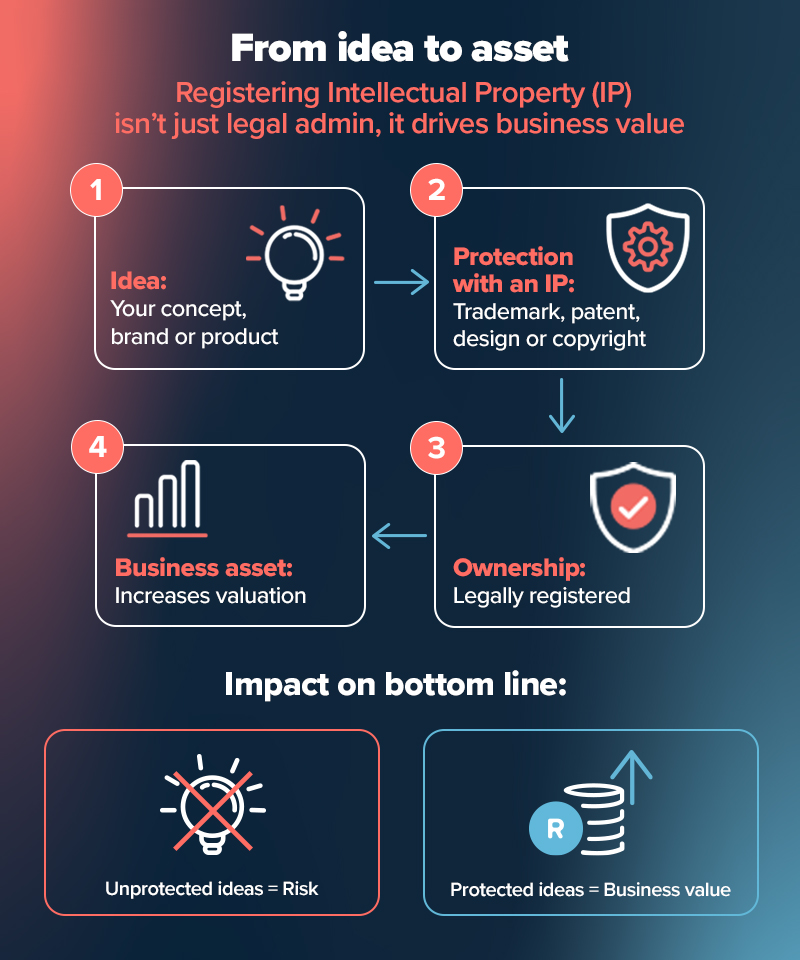
The same is true of the basics of business formalisation, like making sure your CoR 14.3 certificate is sorted before approaching investors. Businesses that understand the importance of IP early on, and protect it diligently, are better positioned to grow and scale.
2 Categories That Constitute Intellectual Property
Intellectual property is generally divided into two categories or branches: Industrial Property and Copyright. Here’s what each of them is, and how they differ:
Industrial property
Industrial property covers protections for things businesses create commercially – the inventions, brand identifiers and product designs that give you a position in the market. Examples include inventions, trademarks, industrial designs and geographic indications.
Copyright
This type of IP refers more to creative works like literature, films, music, artistic works and architectural designs.
One of the main distinctions between the two is that works under the copyright umbrella are protected by default, as long as you keep adequate records.
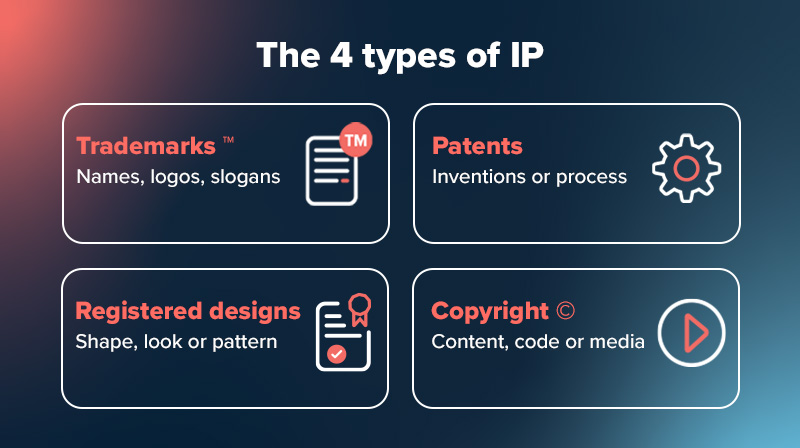
The 4 Main Types of Intellectual Property Rights
Your business is made up of many different moving parts, and protecting all the parts needs a clear strategy. For example, you won’t protect a logo the same way you do your recipes. Here’s how each type of IP protection works under South African law.
How intellectual property protection works in South Africa
Trademarks
A trademark is something that makes your brand recognisable to customers, such as your brand name, logo or even distinct packaging. If, for example, you run a successful coffee shop in your suburb, with a unique menu and decor, there is nothing stopping a competitor from opening another coffee shop in the same suburb, with a similar menu and decor – unless you have a trademark in place.
Registering a trademark is an easy first step you can take to secure legal protection for your business against copycats. In South Africa, it can be done through the Companies and Intellectual Property Commission (CIPC), lasts 10 years and can be renewed for as long as you want.
Once registered, you have exclusive rights to your brand name and logo in your industry. You can license your trademark, sell it, or use it as a balance sheet asset thereafter.
If you want a step-by-step walkthrough of the CIPC process for trademarks, patents, and designs, our guide on how to register your business idea covers the practical steps.
Patents
Patent protection applies to new inventions and functional improvements – in other words, things or processes that do something new. These could be a new piece of equipment, a new manufacturing process, or a technical innovation.
A patent in South Africa is valid for 20 years from the filing date, with annual renewal fees payable to the CIPC every year from the end of the third year onwards.
Patents are more expensive and complex to register than trademarks, which is why most small businesses work with intellectual property legal professionals to handle the application. For the right business, though, the long-term protection is well worth the upfront investment. In South Africa, patents are protected by the Patents Act 57 of 1978.
For a patent to be successfully filed in South Africa, it must meet the following core requirements:
- It must be new or novel – that means it can’t exist anywhere in the world, even on a website or YouTube video
- It must be inventive – meaning it shouldn’t be something obvious to a person skilled in a particular area or field
- It must be useful – it must be something which can actually work and be useful in a real-world application
Registered designs
Another type of intellectual property worth knowing about is registered designs.
Rather than protecting your brand or how something works, registered designs protect the appearance of a product. Registered designs can protect things like the design of a water bottle, the visual pattern on a piece of decor, or the design of a piece of furniture.
In South Africa, registered designs come in two different forms: aesthetic designs and functional designs.
Aesthetic designs protect visual appeal and are valid for 15 years. Functional designs protect how something is shaped to work, and are valid for 10 years.
If your business relies heavily on the look or form of a product, registering the design can be the difference between owning an edge and watching competitors copy it.
Copyright
Copyright is different to the other types of intellectual property in that you don’t need to register it for it to exist. In South Africa, copyright protection is automatic; however, you still need to be diligent about record-keeping.
Senamiso Moyo, intellectual property expert at Legal Ninjas, a legal consultancy geared to small businesses, says, “If you create content, articles, photos, artwork, code, or build software, your work is protected by copyright the moment you create it; you don’t need to register anything. But keep records: save your files with dates, document your development process. That paper trail is your proof if someone ever copies you.”
Copyright protects your creative works, such as written content, photos, videos, music and marketing materials. Copyright lasts for a long time – usually for the entire lifetime of the creator plus 50 years after their death.
Why Intellectual Property Matters for Valuation
Here’s something many small business owners in South Africa may not realise: intellectual property can be an asset. In fact, when you handle it correctly, it may be your most powerful asset.
A groundbreaking 2025 study by Ocean Tomo estimates that intangible assets (including IP) now account for approximately 92% of S&P 500 market capitalisation – up from just 17% in 1975. Ocean Tomo calls this shift the ‘economic inversion’, where value has moved from what businesses own to what they create.
In other words, if you’re not documenting your intellectual property, you’re selling your business short – especially if you want to raise capital or sell down the line. Think of your intellectual property like investments that pay dividends. Having a portfolio of trademarks and patents is a simple way to increase the valuation of your business.
But this isn’t just a global trend. South African law recognises IP as a balance sheet asset. Section 40 of the Companies Act 71 of 2008 acknowledges intellectual property as something with measurable value for shareholding purposes.
If an investor does due diligence on your business, one of the first things they’ll probably ask is what IP is registered, in whose name, and how defensible it is.

The same applies when you’re selling the business.
Buyers value your IP separately, and they discount heavily for anything that isn’t documented. The unfortunate reality is that most South African small businesses pay little attention to securing their IP. And if they do, they usually think about it too late.
Moyo adds, “The real mistake is not thinking about it early enough. By the time your business is taking off or your product is working, that’s exactly when competitors pay attention, too. If you haven’t protected yourself by then, you could be stuck trying to prove ownership after the fact, which is slow and expensive. Protecting your IP before you need to enforce it is always cheaper than trying to enforce it afterwards.”
For many small businesses in South Africa, their IP is genuinely their most valuable asset – they just haven’t formalised it yet. And an asset that exists only in your head isn’t an asset at all in the eyes of an investor or a buyer. Your most valuable asset definitely shouldn’t be invisible.
Ready Your Business For Growth With an Intellectual Property Strategy
Perhaps you never realised the importance of an intellectual property strategy – until now. Or perhaps you did, but never quite had the cash flow to execute on it. Legal fees can add up, and for many businesses, that’s exactly where the IP strategy stalls.
That’s where the right funding partner makes the difference. A Lula Cash Flow Facility gives you flexible access to working capital exactly when you need it – which means you can cover the upfront professional service costs of intellectual property protection without straining your day-to-day operations.
You only pay for what you use, and there are no monthly fees if you don’t draw down. For SMEs that prefer a structured repayment over a flexible line of funding, Lula Fixed-Term Funding offers a once-off lump sum with clear terms.
Every month you delay is a month where a competitor could file a similar trademark first, where you could lose ground in proving original ownership, or where someone else could establish their own claim to a name, design, or invention you’ve been building quietly.
Besides that, knowing the investment, funding and other growth opportunities that a protected IP can unlock for your business is motivation enough to start the process and secure your business’s future.
Securing your IP shouldn’t be seen as an expense; it’s protection of future value, and the cost of acting later is almost always higher than the cost of acting now.
Secure Your Intellectual Property Today
Many SMEs in South Africa don’t fail because they had a bad idea or didn’t work hard. They fail – or stall – because the work they put in was never properly protected.
A great brand without a trademark, a clever invention without a patent, a confidential process without trade secret protection – these are all examples of assets that exist in theory but not on paper. And what isn’t on paper doesn’t show up in valuations or deal negotiations.
Intellectual property should be the foundation that makes the rest of your growth strategy defensible. Whether you’re planning to franchise, attract investors, or eventually sell the business, the work you do with your IP now is what will sustain and help grow your business.
At Lula, we support small businesses with fast access to working capital, which makes acting on your IP strategy possible, instead of pushing it further down the road.
Your most valuable asset shouldn’t be invisible. And it shouldn’t be waiting either.